Today's
EarthStation1.com 15% (Or More!) Off Commemorative Memorial Title:
TV Commercials: The Classics Vol. 2 DVD, Video Download, USB Drive
Today, July 11, 2026
July 11: National Polyphenol Day: -- A
day dedicated to polyphenols, which is a type of micronutrient
found in plants. These micronutrients work as natural energy
boosters and can give a variety of health benefits as well as
protection from aging-related damage. Polyphenol-rich consumables
consist of tea, extra-virgin olive oil, cocoa and its derivative
chocolate (especially dark), onions, flax seed and other cereals,
fruits such as apples, grapes, cherries (especially tart and dark
cherries), citrus fruits, red colored fruits like watermelon and
strawberries, and dark-colored red and blue fruits and berries
like pomegranates and blueberries. A diet rich in polyphenols is
recommended by Dr. Steven Gundry, a distinguished cardiovascular
surgeon who specializes in nutrition and the treatment of aged
people. Supported mental clarity and a healthy heart are two
potential benefits of a polyphenol-rich diet. The word
'polyphenol' comes from the Ancient Greek word 'polus,' which
means 'many.' The term phenol refers to a chemical structure that
is created by adding a hydroxyl group to an aromatic benzenoid
ring. Since at least 1894, the term polyphenol has been in use. In
2021, the Gundry MD team declared July 11 to be National
Polyphenol Day in celebration of the company's founder, Dr. Steven
Gundry's birthday. Gundry was born on July 11, 1950. In the 1990s,
he worked on cardiac surgery research. Gundry received a B.A. from
Yale University in 1972 and a medical doctorate from the Medical
College of Georgia in 1977. Gundry wrote over 300 articles and
filed multiple medical device patents during his time as a
cardiothoracic surgeon. He founded the International Heart &
Lung Institute in Palm Springs, California, in 2002, as a
transition from his position as Clinical Professor of
Cardiothoracic Surgery at the Seventh-day Adventist Loma Linda
University School of Medicine to private practice. Dr. Gundry
established Gundry MD in 2016 as a wellness blog, YouTube channel,
and supplement firm to help individuals regain their health. The
purpose of National Polyphenol Day is to raise awareness and
educate people about the amazing benefits of polyphenols. On Sale
Until Midnight Tonight PT!
https://store.earthstation1.com/tv-commercials-the-classics-vol-2-dv2.html
Today's
EarthStation1.com 15% (Or More!) Off Commemorative Memorial Title:
Vintage Nude Photos Art History 40K+ JPG Image Set DVD, Download,
USB
Today, July 11, 2026
July 11: National Swimming Pool Day: -- A
day not just a celebration of swimming pools, but also of all the
paraphernalia that accompanies pools, such as pool toys,
accessories, and swimwear. Think back to your favorite pool
memories, and make today worthy of adding to your memory bank.
What makes the perfect pool day? Is it the chance to show off that
summer bod, looking fabulous in the latest swimwear designs, or
maybe the fact that you love the exercise that swimming provides?
Or perhaps you love poolside barbeques and the very thought of it
gets your mouth watering. Whatever the reason, we are sure glad
that someone long ago thought of the concept of a swimming pool,
which makes summer a lot more enjoyable (and the heat more
bearable) altogether. While there is no clear intimation of when
National Swimming Pool Day was first founded or observed, we can
track the origin of the swimming pool itself. Some sources trace
the first swimming pool-like structure all the way back to 3000
B.C. in Mohenjo-Daro (in modern-day Pakistan), where a 40 by
23-foot pool was discovered, lined with bricks and covered with a
tar-like sealant. Years later, the Romans built artificial pools
in which to conduct military exercises, nautical games, and
athletic training. The Roman emperors would often have private
pools with fish in them, hence one of the Latin words for 'pool'
is 'piscina,' meaning 'fish pond.' A rich Roman lord and patron of
the arts, Gaius Maecenas, is said to have built the first heated
swimming pool in 100 B.C. By the mid-1800s, swimming pools gained
popularity in Britain, with the earliest indoor pools with diving
boards being built in 1837. The Maidstone Swimming Club, founded
in 1844 in Maidstone, Kent, is one of the oldest surviving
swimming clubs in Britain. The idea behind its formation was to
teach people to swim and therefore survive drowning - following a
spate of drownings that happened in the rivers in the area. The
oldest known swimming pool in the U.S. is called Underwood Pool,
located in Belmont, Massachusetts. It was only after World War II
that home swimming pools became popular in America, and Hollywood
movie stars' luxury homes with pools made this an all the more
desirable symbol of status. Nowadays, the U.S. has more than 10.4
million home pools, though New Zealand holds the record for most
swimming pools per capita. And here we thought they only had a lot
of sheep! On Sale Until Midnight Tonight PT!
https://store.earthstation1.com/vintage-nude-photos-dvd-40000-pics-nudes-in-art-and-hi40000.html
Today's
EarthStation1.com 15% (Or More!) Off Commemorative Memorial Title:
Alternative Revolver Beatles MP3 CD Audio Download USB Flash Drive
Today, July 11, 2026
July 11: National Cheer Up The Lonely
Day: Each year on July 11th, people across the United States make
a special effort to give someone a lift on National Cheer Up The
Lonely Day. If you know someone who is lonely or going through a
difficult time, be a bright spot in their life with a little extra
thoughtfulness today. Whether their loneliness is due to health
issues, financial reasons, grief due to loss or personal reasons,
isolation can be overwhelming. Use this day as a reminder to
contact those people in your life who need a little extra love and
attention. Your small act of kindness can make a big difference to
them. One word or special consideration may brighten their world
at just the right moment. As the old saying goes, "A burden
shared is a burden halved; joy shared is joy doubled." We are
all lonely from time to time. The gift of companionship and
support when we least expect it may not solve our problems, but it
eases the burden a little. While visiting may be the number one
thing to do to observe Cheer Up The Lonely Day, here are a few
other ideas to try: Deliver a few spare magazines to an ailing
friend; Watch a movie with them and share some freshly popped
popcorn; Read a book out loud to your friend; Set up a playlist
with inspirational music; Offer to go for a walk with them; Mail a
sweet or funny card; Bake one of their favorite foods; Call and
visit on the phone; Email funny jokes every day to remind them to
laugh; Play a board game; Go for a drive; Play 20 questions; Watch
funny YouTube videos; Use #CheerUpTheLonelyDay to share on social
media. Research by NationalDayCalendar.com found Francis Pesek of
Detroit, Michigan created this day. His daughter, L.J. Pesek
reports that he "was a quiet, kind, wonderful man who had a
heart of gold. The idea came to him as a way of promoting kindness
toward others who were lonely or forgotten as shut-ins or in
nursing homes." July 10th was Mr. Pesek's birthday. On Sale
Until Midnight Tonight PT!
https://store.earthstation1.com/alternative-revolver-beatles-mp3-cd-audio-download-usb-flash-driv3.html
Today's
EarthStation1.com 15% (Or More!) Off Commemorative Memorial Title:
New York City History Documentary Collection MP4 Video Download
DVD
Today, July 11, 2026
July 11, 2025: New York City (New York,
NYC): The History Of New York City: Manhattan: Manhattanhenges:
Full-Sun Manhattanhenge Day: -- Full-Sun Manhattanhenge occurs,
when the full setting Sun's disk is visible above the horizon as
it lines up with the east-west streets of the main street grid of
Manhattan, New York City. Excellent places for viewing
Manhattanhenge are 14th, 23rd, 34th, 42nd, and 57th Streets.
Manhattanhenge, also jocularly called the Manhattan Solstice, an
event during which the setting sun or the rising sun is aligned
with the east-west streets of the main street grid of Manhattan,
New York City. The sunsets and sunrises each align twice a year,
on dates evenly spaced around the summer solstice and winter
solstice. The Summer Solstice 2025 Manhattanhenge dates are as
follows: On May 29, 2025, Half-Sun Manhattanhenge occurs, when the
upper half of the setting Sun's disk is visible above the horizon;
On May 30, 2025, Full-Sun Manhattanhenge occurs, when the full
setting Sun's disk is visible above the horizon; On July 11, 2025,
Full-Sun Manhattanhenge occurs, when the full setting Sun's disk
is visible above the horizon; On July 12, 2025, Half-Sun
Manhattanhenge occurs, when the upper half of the setting Sun's
disk is visible above the horizon. The term Manhattanhenge was
coined in 1997 by astrophysicist and native New Yorker Neil
deGrasse Tyson of The American Museum of Natural History in their
magazine "Natural History". It is a reference to
Stonehenge, the prehistoric monument located in Wiltshire,
England, which was constructed so that the rising sun, seen from
the center of the monument at the time of the summer solstice,
aligned with the outer "Heel Stone" of the monument. The
precise dates of Manhattanhenge depend on the date of the summer
solstice, which varies from year to year, but remains close to
June 21. #FullSunManhattanhenge #Manhattanhenge #ManhattanSolstice
#SummerSolstice #EstivalSolstice #Midsummer #WinterSolstice
#HibernalSolstice #Midwinter #NeilDerasseTyson #Manhattan
#ManhattanStreetGrid #CommissionersPlanOf1811 #MP4 #VideoDownload
#DVD On Sale Until Midnight Tonight PT!
https://store.earthstation1.com/new-york-city-history-videos-3-dvd-se3.html
Today's
EarthStation1.com 15% (Or More!) Off Commemorative Memorial Title:
The American Adventure: TV History Series 1607-1876 DVD MP4 USB
Drive
Today, July 11, 2026
July 11, 1804: The United States: The
History Of The United States: Dueling: Dueling In The United
States: The Burr-Hamilton Duel: -- Alexander Hamilton, former
Secretary of the Treasury, is mortally wounded in a duel with the
Vice President Of The United States Aaron Burr, dying the next
day. The Burr-Hamilton duel was fought between prominent American
politicians Aaron Burr, the sitting Vice President of the United
States, and Alexander Hamilton, the former Secretary of the
Treasury, at Weehawken, New Jersey on July 11, 1804. The duel was
the culmination of a long and bitter rivalry between the two men.
Hamilton shot first, only to miss and hit a tree directly behind
Burr, who then responded by shooting and mortally wounding
Hamilton, who was carried to the home of William Bayard, where he
died the next day. The duel was the final skirmish of a long
conflict between Democratic-Republicans and Federalists. The
conflict began in 1791 when Burr won a United States Senate seat
from Philip Schuyler, Hamilton's father-in-law, who would have
supported Federalist policies. (Hamilton was the Secretary of the
Treasury at the time.) The Electoral College then deadlocked in
the election of 1800, during which Hamilton's maneuvering in the
House of Representatives caused Thomas Jefferson to be named
president and Burr vice-president. When it became clear that
Jefferson would drop Burr from his ticket in the 1804 election,
Vice President Burr ran for the governorship of New York instead.
Hamilton campaigned vigorously against Burr, who was running as an
independent, causing him to lose to Morgan Lewis, a
Democratic-Republican endorsed by Hamilton. Both men had been
involved in duels in the past. Hamilton had been a principal in 10
"shotless" (averted) duels prior to his fatal encounter
with Burr, including James Monroe in 1797. Hamilton also claimed
that he had one previous honor dispute with Burr; Burr stated that
there were two. It was Burr who challenged Hamilton. On Sale Until
Midnight Tonight PT!
https://store.earthstation1.com/the-american-adventure-series-us-1st-century-4-dv14.html
Today's
EarthStation1.com 15% (Or More!) Off Commemorative Memorial Title:
Portraits Of American Presidents Nos. 1-42 TV Series MP4 Download
DVD
Today, July 11, 2026
July 11, 1767: #BOTD: #HBD! John Quincy
Adams, American lawyer and politician, 6th President of the United
States and son of the 2nd President, John Adams (d. February 23,
1848) is #born in Braintree, Massachusetts. He was an American
statesman who served as the sixth President of the United States
from 1825 to 1829 at the peak of a political career during which
he served in various capacities as diplomat, United States
Senator, United States Secretary Of State, and U.S. Representative
from Massachusetts. He was the eldest son of second president John
Adams (served 1797-1801) and his wife, Abigail Adams. Initially a
Federalist like his father, he successively joined the
Jeffersonian Democratic-Republican, National Republican,
Anti-Masonic, and Whig parties. Adams's commitment to U.S.
republican values shaped early American foreign policy. As a
diplomat, Adams played an important role in negotiating key
treaties, including the Treaty Of Ghent, which ended the War Of
1812 (1812-1815). As Secretary Of State under fifth president
James Monroe, he negotiated with Great Britain in 1818 over the
United States' northern border with Canada, negotiated the
Adams-Onis Treaty with Spain, which allowed for the annexation of
Florida, and drafted the "Monroe Doctrine". Historians
generally concur that he was one of the greatest diplomats and
secretaries of state in American history. Biographer Samuel Flagg
Bemis argues that Adams was able to "gather together,
formulate, and practice the fundamentals of American
foreign-policy - self-determination, independence,
noncolonization, nonintervention, nonentanglement in European
politics, Freedom of the Seas, [and] freedom of commerce."
Adams was elected president in a close and controversial four-way
contest in 1824. As president, he sought to promote education and
to modernize the American economy under an economic policy known
as the American System, rooted in the American School ideas of
Alexander Hamilton, a plan that Senator Henry Clay, the plan's
foremost proponent, said "consisted of three mutually
reinforcing parts: a tariff to protect and promote American
industry; a national bank to foster commerce; and federal
subsidies for roads, canals, and other 'internal improvements' to
develop profitable markets for agriculture". Adams enacted
part of his agenda and paid off much of the national debt.
However, he was stymied time and again by a hostile Congress, and
his lack of patronage networks helped politicians sabotage him. He
lost his 1828 bid for re-election to Andrew Jackson. Recent
historians have portrayed him as a moral leader during an era of
modernization when new modes of communication spread messages of
religious revival, social reform, and party politics, and when
improved transportation moved goods, money, and people more
rapidly. He is generally ranked as an above-average president.
After leaving the presidency in 1829, Adams was elected U.S.
Representative from Massachusetts, serving for the last seventeen
years of his life with greater acclaim than he had achieved as
president. Animated by his growing revulsion against slavery,
Adams became a leading opponent of the Slave Power. Adams
predicted the Union's dissolution over slavery, and felt that in
such a crisis the president could abolish slavery by using his war
powers. Adams also became a critic of the annexation of Texas and
of the Mexican-American War, which he saw as an aggressive war for
territory. After serving just one term as President, he served 17
years as a member of Congress. He died of the effects of a massive
cerebral hemorrhage at 7:20 p.m. in the Speaker's Room inside the
Capitol Building in Washington, D.C., the same room in which he
had taken the presidential Oath of Office, with his wife at his
side and freshmen Illinois representative Abraham Lincoln present;
his only living child, Charles Francis, did not arrive in time to
see his father alive. His last words were "This is the last
of Earth. I am content". Two days prior, on February 21,
1848, the House of Representatives was discussing the matter of
honoring United States Army officers who served in the
Mexican-American War. Adams had been a vehement critic of the war,
and as Congressmen rose up to say, "Aye!" in favor of
the measure, he instead yelled, "No!" He rose to answer
a question put forth by Speaker of the House Robert Charles
Winthrop. Immediately thereafter, Adams collapsed from his brain
hemorrhage. He is buried at the United First Parish Church in
Quincy, Massachusetts. He was the the first president whose father
had also been president. On Sale Until Midnight Tonight PT!
https://store.earthstation1.com/portraits-of-american-presidents-nos-142-tv-series-mp4-download1424.html
Today's
EarthStation1.com 15% (Or More!) Off Commemorative Memorial Title:
Portraits Of The Presidency: POTUS Documentaries DVD, Download,
USB
Today, July 11, 2026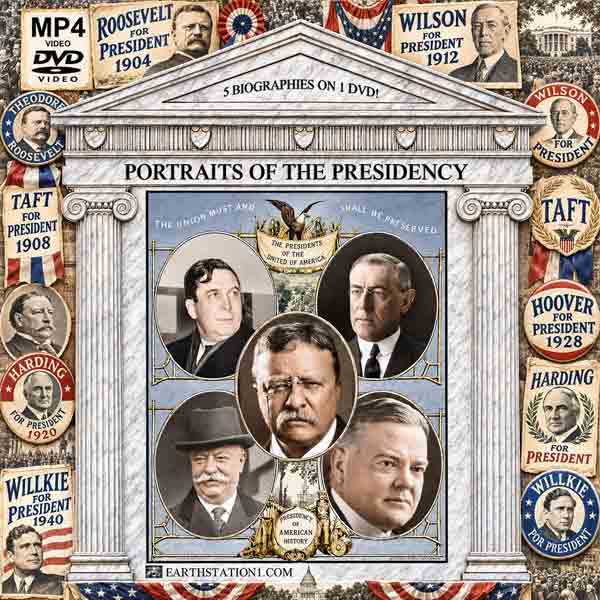
July 11, 1921: The United States: The
History Of The United States: The Supreme Court Of The United
States (SCOTUS): Appointments To The Supreme Court Of The United
States (SCOTUS): The Swearing-In Of Chief Justice Of The Supreme
Court William Howard Taft: -- Former President of the United
States William Howard Taft is sworn in as 10th Chief Justice of
the U.S. Supreme Court, becoming the only person ever to hold both
offices, a position in which he served until a month before his
death. U.S. President Warren G. Harding appointed Taft as Chief
Justice on June 30, 1921. Despite his personal ambition to become
chief justice, Taft declined repeated offers of appointment to the
Supreme Court Of The United States, believing his political work
to be more important. By Taft's later account, after some
conversation, Harding casually asked if Taft would accept
appointment to the Supreme Court; if Taft would, Harding would
appoint him. Taft had a condition for Harding - having served as
president, and having appointed two of the present associate
justices and opposed Brandeis, he could accept only the chief
justice position. Harding made no response, and Taft in a
thank-you note reiterated the condition and stated that Chief
Justice White had often told him he was keeping the position for
Taft until a Republican held the White House. In January 1921,
Taft heard through intermediaries that Harding planned to appoint
him, if given the chance. Harding was also considering a proposal
by Justice William R. Day to crown his career by being chief
justice for six months before retiring. Taft felt, when he learned
of this plan, that a short-term appointment would not serve the
office well, and that once confirmed by the Senate, the memory of
Day would grow dim. After Harding rejected Day's plan, Attorney
General Harry Daugherty, who supported Taft's candidacy, urged him
to fill the vacancy, and he named Taft on June 30, 1921. The
Senate confirmed Taft the same day, 61-4, without any committee
hearings and after a brief debate in executive session. Taft drew
the objections of three progressive Republicans and one southern
Democrat. When he was sworn in on July 11, he became the first and
to date only person to serve both as president and chief justice.
When Taft became chief justice, the court did not have its own
building and met in the Capitol. Its offices were cluttered and
overcrowded, but Fuller and White had been opposed to proposals to
move the court to its own building. In 1925, Taft began a fight to
get the court a building, and two years later Congress
appropriated money to purchase the land, on the south side of the
Capitol. Cass Gilbert had prepared plans for the building, and was
hired by the government as architect. Taft had hoped to live to
see the court move into the new building, but it did not do so
until 1935, after Taft's death. Chief Justice Taft was a
conservative on business issues and under him there were advances
in individual rights. In poor health, he resigned in February
1930, and died the following month. He was buried at Arlington
National Cemetery, the first president and first Supreme Court
justice to be interred there. Taft is generally listed near the
middle in historians' rankings of U.S. presidents. #WarrenGHarding
#WilliamHowardTaft #POTUS #POTUSHistory #AmericanPresidents
#ChiefJustice #SCOTUS #AmericanHistory #USHistory #HistoryOfTheUS
#WesternCulture #WesternCivilization #OccidentalCulture
#WesternWorld #WesternSociety #WesternTradition
#StoryOfCivilization #MP4 #VideoDownload #DVD On Sale Until
Midnight Tonight PT!
https://store.earthstation1.com/portraits-of-the-presidency-roosevelt-wilson-hoover-taft-willkie.html
Today's
EarthStation1.com 15% (Or More!) Off Commemorative Memorial Title:
Monarchy In The UK: British Royal History MP4 Video Download DVD
Set
Today, July 11, 2026
July 11, 1274: #BOTD: #HBD! Robert I,
popularly known as Robert The Bruce (Scottish Gaelic: Raibeart Am
Brusach), Scottish king and national hero who led Scotland during
the First War of Scottish Independence against England to
successfully restore Scotland to an independent kingdom, King of
Scots from 1306 until his death twenty three years later (d. June
7, 1329) is #born, His place of birth is not known for certain; it
most likely was Turnberry Castle in Ayrshire, the head of his
mother's earldom, despite claims that he may have been born in
Lochmaben in Dumfriesshire, or Writtle in Essex. Robert was a
fourth-great-grandson of King David I of Scotland, and his
grandfather, Robert de Brus, 5th Lord of Annandale, was one of the
claimants to the Scottish throne during the "Great Cause".[1]
As Earl of Carrick, Robert The Bruce supported his family's claim
to the Scottish throne and took part in William Wallace's campaign
against Edward I of England. Appointed in 1298 as a Guardian of
Scotland alongside his chief rival for the throne, John Comyn of
Badenoch, and William Lamberton, Bishop of St Andrews, Robert
resigned in 1300 because of his quarrels with Comyn and the
apparently imminent restoration of John Balliol to the Scottish
throne. After submitting to Edward I in 1302 and returning to "the
king's peace", Robert inherited his family's claim to the
Scottish throne upon his father's death. Bruce's involvement in
John Comyn's murder in February 1306 led to his excommunication by
Pope Clement V (although he received absolution from Robert
Wishart, Bishop of Glasgow). Bruce moved quickly to seize the
throne and was crowned king of Scots on 25 March 1306. Edward I's
forces defeated Robert in the Battle of Methven, forcing him to
flee into hiding, before re-emerging in 1307 to defeat an English
army at Loudoun Hill and wage a highly successful guerrilla war
against the English. Robert I defeated his other opponents,
destroying their strongholds and devastating their lands, and in
1309 held his first parliament. A series of military victories
between 1310 and 1314 won him control of much of Scotland, and at
the Battle of Bannockburn in 1314, Robert defeated a much larger
English army under Edward II of England, confirming the
re-establishment of an independent Scottish kingdom. The battle
marked a significant turning point, with Robert's armies now free
to launch devastating raids throughout northern England, while he
also expanded the war against England by sending armies to invade
Ireland, and appealed to the Irish to rise against Edward II's
rule. Despite Bannockburn and the capture of the final English
stronghold at Berwick in 1318, Edward II refused to renounce his
claim to the overlordship of Scotland. In 1320, the Scottish
nobility submitted the Declaration of Arbroath to Pope John XXII,
declaring Robert as their rightful monarch and asserting
Scotland's status as an independent kingdom. In 1324, the Pope
recognised Robert I as king of an independent Scotland, and in
1326, the Franco-Scottish alliance was renewed in the Treaty of
Corbeil. In 1327, the English deposed Edward II in favour of his
son, Edward III, and peace was concluded between Scotland and
England with the Treaty of Edinburgh-Northampton in 1328, by which
Edward III renounced all claims to sovereignty over Scotland.
Robert I died at the Manor of Cardross, near Dumbarton. It remains
unclear just what caused the death of Robert, a month before his
fifty-fifth birthday. Contemporary accusations that Robert had
leprosy, the "unclean sickness" - the present-day,
treatable Hansen's disease - derived from English and Hainault
chroniclers. A team of researchers, headed by Professor Andrew
Nelson from University of Western Ontario, have determined that
Robert The Bruce did not have leprosy. Along with suggestions of
eczema, tuberculosis, syphilis, motor neurone disease, cancer or
stroke, a diet of rich court food has also been suggested as a
possible contributory factor in Robert's death. His Milanese
physician, Maino De Maineri, did criticise the king's eating of
eels as dangerous to his health in advancing years. He was
succeeded by his son, David II. Robert's body is buried in
Dunfermline Abbey, while his heart was interred in Melrose Abbey,
and his internal organs were embalmed and placed in St Serf's
Church, Dumbarton. On Sale Until Midnight Tonight PT!
https://store.earthstation1.com/monarchy-in-the-uk-british-royal-history-mp4-video-download-dvd-set.html
Today's
EarthStation1.com 15% (Or More!) Off Commemorative Memorial Title:
The French Revolution Series + Irish Rebellion & You Are There
MP4 DVD
Today, July 11, 2026
July 11, 1789: The Age Of Enlightenment
(The Enlightenment, The Age Of Reason): The Age Of Revolution: The
Atlantic Revolutions: The French Revolution: The Storming Of The
Bastille (French: Prise De La Bastille): The Dismissal Of Jacques
Necker): -- The French Revolution is sparked when Jacques Necker
is dismissed as France's Finance Minister. Jacques Necker was a
banker of Genevan origin who became a French statesman and finance
minister for Louis XVI. He held the finance post during the period
1777-1781 and helped make decisions that were critical in creating
political and social conditions that contributed to the outbreak
of the French Revolution in 1789. Necker is remembered today for
taking the unprecedented step in 1781 of making public the
country's budget, a novelty in an absolute monarchy where the
state of finances had always been kept a secret. Necker was viewed
as the savior of France by many as the country stood on the brink
of ruin, but his actions could not stop the French Revolution.
Also, his address at the Estates-General was terribly
miscalculated: it lasted for hours, and while those present
expected a reforming policy to save the nation, he gave them
financial data. This approach had serious repercussions on
Necker's reputation; he appeared to consider the Estates-General
to be a facility designed to help the administration rather than
to reform government. Necker's dismissal on July 11, 1789,
provoked by his decision not to attend Louis XVI's speech to the
Estates-General, enraged the people of France and sparked rumors
that the king meant to attack Paris or arrest the deputies. These
fears and the foreign and French troops - called by the King -
surrounding Paris and the National Assembly provoked the storming
of the Bastille on 14 July. The king recalled Necker on July 19.
He was received with joy in every city he traversed, but in Paris
he again proved to be no statesman. Believing that he could save
France alone, he refused to act with the Comte de Mirabeau or
Marquis de Lafayette, the most prominent statesmen at the time.
Necker stayed in office until 1790, but his efforts to keep the
financial situation afloat were ineffective. His popularity
vanished and he resigned with a damaged reputation. On Sale Until
Midnight Tonight PT!
https://store.earthstation1.com/the-french-revolution-dvd-3-part-tv-documentary-serie3.html
Today's
EarthStation1.com 15% (Or More!) Off Commemorative Memorial Title:
Television Broadcasting History Films MP4 Video Download DVD Set
Today, July 11, 2026
July 11, 1962: The History Of Rocketry:
The History Of Spaceflight: The Aftermath Of World War II: The
Cold War: The Spage Age: The Space Race: The United States Space
Program: Earth Satellites: Weather Satellites (Meteorological
Satellites: Communications Satellites: Telstar 1 (Telstar): The
History Of Broadcasting: The History Of Television Broadcasting:
Transatlantic Satellite Television Transmissions: -- The first
transatlantic satellite television transmission occurs during a
test broadcast via the just-launched communications satellite
Telstar 1, better known as Telstar. The first public satellite
television signals from Europe to North America were relayed via
the Telstar satellite over the Atlantic ocean on 23 July 1962. The
public transmission signals were received and broadcast in North
American and European countries and watched by over 100 million.
The day before, on July 10, 1962, Telstar 1, best known simply as
Telstar, the first of the Telstar series and the world's first
communications satellite, was launched into medium orbit from Cape
Canaveral, and was the first privately sponsored space launch.
Telstar is the name of various communications satellites produced
by American Telephone And Telegraph (ATT). The first two Telstar
satellites were experimental and nearly identical. Telstar 1
launched on top of a Thor-Delta rocket on July 10, 1962. It
successfully relayed through space the first television pictures,
telephone calls, and telegraph images, and provided the first live
transatlantic television feed, capabilities which were perfected
later in the sixties with Early Bird and other Intelsat satellites
(communications satellites providing international broadcast
services owned and managed by an intergovernmental consortium).
Telstar 2 launched May 7, 1963. Telstar 1 and 2-though no longer
functional-still orbit the Earth. On Sale Until Midnight Tonight
PT!
https://store.earthstation1.com/television-broadcast-history-dual-layer-dvd.html
Today's
EarthStation1.com 15% (Or More!) Off Commemorative Memorial Title:
Black Civil Rights Films: African-American History DVD, MP4, USB
Stick
Today, July 11, 2026
July 11, 1905: Civil Rights Movements:
The American Civil Rights Movement (1896-1954) (The Jim Crow Era):
Civil Rights Organizations (Civil Rights Movement Organizations):
African American Civil Rights Organizations (Civil Rights Movement
Organizations): The Niagara Movement (NM): The Niagara Falls
Conference (The First Niagara Falls Conference) (July 11-14,
1905): -- "The Original Twenty-Nine", the twenty-nine
African American founders of The Niagara Movement led by W. E. B.
Du Bois, John Hope, and William Monroe Trotter, arrive from
fourteen states at the Erie Beach Hotel, Fort Erie, Ontario, on
the Canadian side of the Niagara River, for their inaugural
meeting. The First Niagara Conference was originally scheduled for
Buffalo, New York, but because of threatened disruptions from
partisans of the politically powerful Booker T. Washington, they
fled at the last minute to the Erie Beach Hotel in Fort Erie,
Ontario, Canada. Du Bois described the meeting as "secret".
One Bookerite, Clifford Plummer, traveled to Buffalo to check up
on the proceedings, looked around, and "happily"
reported back that there was no conference. To disguise their
conference, they publicly announced that they were refused
accommodation for it, not in Fort Erie where it actually was, but
in Buffalo, New York instead. Accordingly, there is no no evidence
that any Buffalo hotels denied such accommodation. According to
contemporary reports, Buffalo hotels complied with a statewide
anti-discrimination law passed in 1895. The attendees of the
inaugural meeting drafted a "Declaration of Principles,"
primarily the work of Du Bois and Trotter. The group's philosophy
contrasted with the conciliatory approach by Booker T. Washington,
who proposed patience over militancy. The declaration defined the
group's philosophy and demands: politically, socially and
economically. It described the progress made by "Negro-Americans",
"particularly the increase of intelligence, the buy-in of
property, the checking of crime, the uplift in home life, the
advance in literature and art, and the demonstration of
constructive and executive ability in the conduct of great
religious, economic and educational institutions." It called
for blacks to be granted manhood suffrage, for equal treatment for
all American citizens alike. Very specifically, it demanded equal
economic opportunities, in the rural districts of the South, where
many blacks were trapped by sharecropping in a kind of indentured
servitude to whites. This resulted in "virtual slavery".
The Niagara Movement wanted all African Americans in the South to
have the ability to "earn a decent living". On the
subject of education, the authors declared that not only should it
be free, but it should also be made compulsory. Higher education,
they declared, should be governed independently of class or race,
and they demanded action to be taken to improve "high school
facilities." This they emphasized: "either the United
States will destroy ignorance, or ignorance will destroy the
United States." They demanded for judges to be selected
independently of their race, and for convicted criminals, white or
black, to be given equal punishments for their respective crimes.
In his address to the nation, W. E. B. Du Bois stated, "We
are not more lawless than the white race; we [are] more often
arrested, convicted and mobbed. We want justice, even for
criminals and outlaws." He called for the abolition of the
convict lease system. Established after the Civil War before
southern states built prisons, convicts were leased out to work as
cheap laborers for "railway contractors, mining companies and
those who farm large plantations." Southern states had passed
laws targeting blacks and leasing them out to pay off fines or
fees they could not manage. The system continued, earning money
for local jurisdictions and the state from leasing out prisoners.
There was little oversight, and many prisoners were abused and
worked to death. Urging a return to the faith of "our
fathers," the declaration appealed for every person to be
considered equal and free. The declaration also targeted the
treatment blacks received from labor unions, often oppressed and
not fully protected by their employers nor granted permanent
employment. It validated the already announced affirmation that
such protest against outright injustice would not cease until such
discrimination did. Secondly, Du Bois and Trotter stated the
irrationality of discriminating based on one's "physical
peculiarities", whether it be place of birth or color of
skin. Perhaps one's ignorance, or immorality, poverty or diseases
are legitimate excuses, but not the matters over which individuals
have no control. Near its end, the document condemns the Jim Crow
laws, the rejection of blacks for enlistment in the Navy and by
the military academies, the non-enforcement of the 13th, 14th and
15th Amendments protecting the rights of blacks, and the
"unchristian" behaviors of churches that segregate and
show prejudice to their black brothers. The Declaration thanked
those who "stand for equality" and the advancement of
this cause. Booker T. Washington and his supporters tried to
discourage growth of this rival movement. Washington, Thomas
Fortune, and Charles Anderson met after learning of the Movement's
formation, and agreed to suppress news of it in the black press.
They acquired supporters in Archibald Grimke and Kelly Miller, two
moderates who had been friendly with Trotter, but had not been
invited by Du Bois to the convention (Grimke was hired by
Fortune's New York Age). The Age editorialized that the Movement
was little more than an attempt to tear down the house that
Washington had labored to set up. A Boston supporter of Washington
convinced the printer of Trotter's Guardian to withdraw his
services, but Trotter managed to continue printing anyway.
Prominent white activists, including Francis Jackson Garrison and
Oswald Garrison Villard (family of abolitionist William Lloyd
Garrison, a hero of Trotter), refused to attend Trotter-organized
commemorations of their father's birth centennial. They chose a
celebration organized by Bookerites. Despite Washington's attempts
at suppression, Du Bois reported at the end of 1905 that a number
of black publications had published accounts of the Movement's
activities, and it received further publicity as a consequence of
Bookerite press attacks against it. Washington also attacked the
Constitution League, a multi-racial civil rights group that was
also opposed to his accommodationist policies. The Movement made
common cause with this organization. The subsequent Niagara
Conference was held the following year at Storer College, Harpers
Ferry, West Virginia. On Sale Until Midnight Tonight PT!
https://store.earthstation1.com/black-civil-rights-films-africanamerican-history-dvd.html
Today's
EarthStation1.com 15% (Or More!) Off Commemorative Memorial Title:
Eyes On The Prize II: America At The Racial Crossroads DVD MP4 USB
Today, July 11, 2026
July 11, 1954: White Supremacy:
Anti-Black Racism: Anti-Black Racism In The United States:
Segregation: Racial Segregation: White Backlash (White Rage,
Whitelash): White Politics Of Resentment (White Politics Of
Grievance, White Politics Of Resentment, White Resentment, White
Grievance): White Nationalism: White Supremacist Organizations:
Segregationist Organizations: The Citizens' Councils (The White
Citizens' Councils, Citizens' Councils Of America): -- The
Citizens' Councils, the white supremacist, segregationist
organizational network concentrated in the American South, is
founded in Indianola, Mississippi, on the same calendar date as
The 1905 African American Civil Right Niagara Movement, as part of
a white backlash against the United States Supreme Court's Brown
v. Board of Education ruling against racial segregation in public
schools made two months prior. The Citizens' Councils (commonly
referred to as the White Citizens' Councils) changed its name to
the Citizens' Councils Of America in 1956. With about 60,000
members across the Southern United States, the Councils worked to
oppose voter registration efforts in the South (where most African
Americans had been disenfranchised since the late 19th century)
and integration of public facilities in general during the 1950s
and '60s. Members employed tactics such as economic boycotts,
unjustified termination of employment, propaganda, and outright
violence. By the 1970s the influence of the Councils had waned
considerably due to the passage of federal civil rights
legislation during the mid 1960s. The councils' mailing lists and
some of their board members found their way to the St. Louis-based
Council of Conservative Citizens, founded in 1985. On Sale Until
Midnight Tonight PT!
https://store.earthstation1.com/eyes-on-the-prize-ii-dvd-set-4-discs-complete-2nd-seri42.html
Today's
EarthStation1.com 15% (Or More!) Off Commemorative Memorial Title:
King: A Filmed Record: Montgomery To Memphis DVD, Download, USB
Drive
Today, July 11, 2026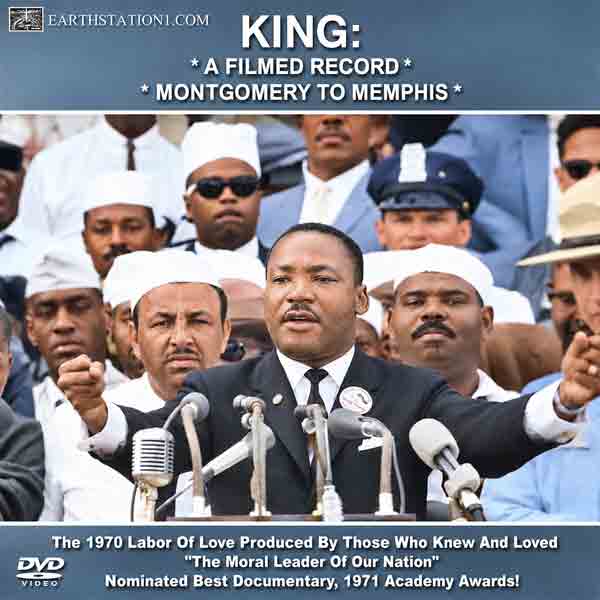
July 11, 1897: #BOTD: Bull Connor,
despicable racist, White supremacist and segregationist, American
politician who served as Commissioner of Public Safety for the
city of Birmingham, Alabama for more than two decades, and a
disgrace to the Freemasonic fraternity, most famous for his
staunch defense of racial segregation and for ordering the use of
police dogs and fire hoses to disperse civil rights demonstrators
in Birmingham during the spring of 1963 (d. March 10, 1973)) is
#born Theophilus Eugene Connor in Dallas County, Alabama. Trained
as a telegraph operator, Connor eventually settled in Birmingham
where he worked as a radio sports announcer. Capitalizing on his
popularity with radio listeners and on his well-know nickname
("Bull"), Connor entered politics in 1934 as a Democrat
and was elected to the Alabama House of Representatives. Connor
was elected Public Safety Commissioner of Birmingham in 1937.
Under the city commission government, Connor had responsibility
for administrative oversight of the Birmingham Fire Department and
the Birmingham Police Department, which also had their own chiefs.
He remained Public Safety Commissioner until 1954, and held the
position again from 1958 to 1963 when he was forced from office by
a change in the form of city government. During his long political
career Connor ran two unsuccessful campaigns for governor of
Alabama and was a leader of the 1948 Dixiecrat revolt. From 1964
to 1973 he served as President of the Alabama Public Service
Commission, the state agency that regulates public utilities. As a
Dixiecrat, Bull Connor strongly opposed the Civil Rights Movement
in the 1960s. He enforced legal racial segregation and denied
civil rights to black citizens, especially during 1963's
Birmingham campaign led by the Southern Christian Leadership
Conference. He is well known for directing the use of fire hoses
and police attack dogs against civil rights activists, including
against children supporting the protests. National media broadcast
these tactics on television, horrifying much of the world. The
outrages served as catalysts for major social and legal change in
the Southern United States and contributed to passage by the
United States Congress of the Civil Rights Act of 1964. On June 3,
1964, Connor resumed a place in government when he was elected
president of the Alabama Public Service Commission. He suffered a
stroke on December 7, 1966, and used a wheelchair for the rest of
his life. Connor won another term in 1968, but was defeated in
1972. He suffered another stroke on February 26, 1973, which left
him unconscious. He died a few weeks later in Birmingham, Alabama,
aged 75. He is buried at the Garden Of Life section of The
Jefferson Memorial Gardens Cemetery in Birmingham, Alabama; people
have been known to urinate on his grave, while doing nothing else
to disrespect the cemetery. On Sale Until Midnight Tonight PT!
https://store.earthstation1.com/king-a-filmed-record--montgomery-to-memphis-dvd.html
Today's
EarthStation1.com 15% (Or More!) Off Commemorative Memorial Title:
Hoover Vs The Kennedys The Second Civil War TV Series MP4 Download
DVD
Today, July 11, 2026
July 11, 1977: Civil Rights Movements:
The American Civil Rights Movement: The Post-Civil Rights Era
(1969-Present): Awards And Decorations: Civil Awards And
Decorations: Civil Awards And Decorations Of The United States:
The Presidential Medal Of Freedom: -- Martin Luther King, Jr.,
American Baptist minister and activist who became the most visible
spokesperson and leader in the civil rights movement from 1954
until his death in 1968, is posthumously awarded the Presidential
Medal Of Freedom by President Jimmy Carter on the anniversaries of
both the foundation of The Niagra Movement of the African American
Civil Rights struggle and the foundation of the White Citizens'
Councils. The Presidential Medal Of Freedom is an award bestowed
by the President of the United States and is-along with the
comparable Congressional Gold Medal-the highest civilian award of
the United States. It recognizes those people who have made "an
especially meritorious contribution to the security or national
interests of the United States, world peace, cultural or other
significant public or private endeavors". The award is not
limited to U.S. citizens and, while it is a civilian award, it can
also be awarded to military personnel and worn on the uniform. It
is often considered to be the American equivalent of a knighthood.
It was established in 1963 by President John F. Kennedy,
superseding the Medal Of Freedom that was established by President
Harry S. Truman in 1945 to honor civilian service during World War
II. On Sale Until Midnight Tonight PT!
https://store.earthstation1.com/hoover-vs-the-kennedys-the-second-civil-war-tv-series-mp4-download-dv4.html
Today's
EarthStation1.com 15% (Or More!) Off Commemorative Memorial Title:
The Gallant Breed: US Marine Chronicles + 2 Bonuses MP4 Download
DVD
Today, July 11, 2026
July 11, 1798: The United States Marine
Corps (USMC) (The United States Marines): The History Of The
United States Marine Corps: -- The United States Marine Corps is
re-established; they had been disbanded after the American
Revolutionary War. The United States Marine Corps was born when
the Second Continental Congress commissioned by its own decree the
innkeeper and former Quaker Samuel Nicholas to raise two
battalions of Continental Marines at Nicholas' Tun Tavern, a
colonial inn in Philadelphia, Pennsylvania. Samuel Nicholas (1744
- August 27, 1790) was the first officer commissioned in the
United States Continental Marines, and by tradition is considered
to be the first Commandant of the Marine Corps. The tavern's
manager, Robert Mullan, was the "chief Marine Recruiter",
and marks the Tun Tavern as the location where the United States
Marines held their first recruitment drive. The decree ordered
"That two battalions of Marines be raised consisting of one
Colonel, two lieutenant-colonels, two majors and other officers,
as usual in other regiments; that they consist of an equal number
of privates as with other battalions, that particular care be
taken that no persons be appointed to offices, or enlisted into
said battalions, but such as are good seamen, or so acquainted
with maritime affairs as to be able to serve for and during the
present war with Great Britain and the Colonies; unless dismissed
by Congress; that they be distinguished by the names of the First
and Second Battalions of Marines." The first Continental
Marine company was composed of one hundred Rhode Islanders
commanded by Captain Nicholas. The earliest Marines were deployed
aboard Continental Congress Navy vessels as sharpshooters because
they were typically recruited as outstanding marksmen. Originally
part of the United States Navy, the United States Marine Corps
became a separate unit on July 11, 1789. Prior to 1921, Marines
celebrated the recreation of the Corps on July 11 with little pomp
or pageantry. On October 21, 1921, Major Edwin North McClellan, in
charge of the Corps's fledgling historical section, sent a
memorandum to Commandant John A. Lejeune, suggesting the Marines'
original birthday of November 10 be declared a Marine Corps
holiday to be celebrated throughout the Corps. Lejeune so ordered
in Marine Corps Order 47, which read in part "The following
will be read to the command on the 10th of November, 1921, and
hereafter on the 10th of November of every year. Should the order
not be received by the 10th of November, 1921, it will be read
upon receipt. On November 10, 1775, a Corps of Marines was created
by a resolution of Continental Congress. Since that date many
thousand men have borne the name "Marine". In memory of
them it is fitting that we who are Marines should commemorate the
birthday of our corps by calling to mind the glories of its long
and illustrious history." The first formal United States
Marine Corps Birthday Ball was celebrated in 1925, though no
records exist that indicate the proceedings of that event.
Birthday celebrations would take varied forms, most included
dances, though some accounts include mock battles, musical
performances, pageants, and sporting events. The celebrations were
formalized and standardized by Commandant Lemuel C. Shepherd, Jr.
in 1952, outlining the cake cutting ceremony, which would enter
the Marine Drill Manual in 1956. By tradition, the first slice of
cake is given to the oldest Marine present, who in turn hands it
off to the youngest Marine present, symbolizing the old and
experienced Marines passing their knowledge to the new generation
of Marines. The celebration also includes a reading of Marine
Corps Order 47, republished every year, as well as a message from
the current Commandant, and often includes a banquet and dancing
if possible. In many cases, the birthday celebration will also
include a pageant of current and historical Marine Corps uniforms,
as a reminder of the history of the Corps. Another modern
tradition includes a unit run on the 10th. Marines are reputed to
celebrate the birthday, regardless of where they may be in the
world, even in austere environments or combat. In a more somber
tradition, Samuel Nicholas's grave in the Arch Street Friends
Meeting graveyard in Philadelphia is marked with a wreath at dawn
by a group of Marines annually on November 10 to celebrate his
role in the founding of the Corps. Tun Tavern was a tavern and
brewery in Philadelphia, Pennsylvania, which was a founding or
early meeting place for a number of notable groups. It is
traditionally regarded as the site where what became the United
States Marine Corps held its first recruitment drive during the
American Revolution. It is also regarded as one of the
"birthplaces of Masonic teachings in America". Although
tradition places the U.S. Marine Corps' first recruiting post at
Tun Tavern, the historian Edwin Simmons surmises that it was more
likely the Conestoga Waggon [sic], a tavern owned by the Nicholas
family. Each year on November 10, U.S. Marines worldwide toast the
memory of the Tun Taven as the officially-acknowledged birthplace
of their service branch. In homage to the likely 1775 Tun Tavern
menu, the U.S. Marine Corps National Museum located in Quantico,
Virginia, contains a Tun Tavern-themed restaurant, whose lunch
menu features beer and other fermented (alcoholic) beverages,
peanut soup and bread pudding, the non-alcoholic recipe of which
remains a traditional staple among some U.S. Marine food services
to this day. The tavern was erected in 1686 at the intersection of
King (later called Water) Street and Tun Alley by settler Joshua
Carpenter, brother of Samuel Carpenter, a Quaker merchant who made
a fortune trading in Barbados. Joshua Carpenter built the Tun on
the caraway that led to Carpenter's Wharf. Tun Tavern was named
for the Old English word "tun", meaning a barrel or keg
of beer. In the 1740s, a restaurant appellation, "Peggy
Mullan's Red Hot Beef Steak Club" was added to the name of
the tavern. Tun Tavern hosted the first meetings of a number of
organizations. In 1720, the first meetings of the St. George's
Society (a charitable organization founded to assist needy
Englishmen arriving in the new colony - predecessor of today's
Sons of the Society of St. George) were held there. In 1732, the
tavern hosted the first meetings of St. John's Lodge No. 1 of the
Grand Lodge Of Pennsylvania Masonic Temple. The Masonic Temple of
Philadelphia recognizes Tun Tavern as the birthplace of Masonic
teachings in America. In 1747, Tun Tavern became the founding
place of the St. Andrew's Society, which like the St. George's
Society, helped newly arrived Scottish. Tun Tavern was a
significant meeting place for other groups and individuals. In
1756, Benjamin Franklin used the inn as a recruitment gathering
point for the Pennsylvania militia as it prepared to fight Native
American uprisings. The tavern later hosted a meeting of George
Washington, Thomas Jefferson and the Continental Congress. In
October 1775 a seven man Naval Committee including John Adams
appointed by Congress crafted articles of war to build America's
first naval fleet. In 1781, near the end of the American
Revolution, Tun Tavern burned down. Its former structure stood at
a location now occupied by Interstate 95, where it passes Penn's
Landing. Tun Alley once existed between Walnut and Chestnut
Streets east of Front Street. A commemorative marker on the east
side of Front Street indicates the site, across from Sansom Walk.
It is listed on Google Maps as located at 125-171 S Front St,
Philadelphia, PA 19106. On Sale Until Midnight Tonight PT!
https://store.earthstation1.com/the-gallant-breed-dvd-set-3-part-us-marine-history-2-dis32.html
Today's
EarthStation1.com 15% (Or More!) Off Commemorative Memorial Title:
Axis Armor: Tanks Of Nazi Germany Japan & Italy MP4 Video
Download DVD
Today, July 11, 2026
July 11, 1943: The European Civil War:
World War II: The Second European War (The European Theater Of
World War II): The Mediterranean And Middle East Theater Of World
War II: The Italian Campaign Of World War II (The Liberation Of
Italy): The Allied Invasion Of Sicily (The Battle Of Sicily,
Operation Husky): The Battle Of Gela (1943): -- German and Italian
troops launch a counter-attack on Allied forces. The Sarasota
Herald Tribune confirmed on July 12 that no less than seven
determined counterattacks against the US beachhead on July 10 and
11 had been carried out by the tanks of the Italian Livorno
Division, reporting "The heaviest of seven Italian
counter-attacks was met and beaten back by American troops in the
Gela area. The attack was launched by the Italian's Fourth Livorno
Division with 45 tanks in support." The first American tanks
were landed at 02:00 on July 11 and these 67th Armor Regiment
vehicles promptly became stuck in soft beach sand. Bent steel
matting intended to support the tanks' weight became entangled in
their treads and bogey wheels. Twelve Italian Savoia-Marchetti
SM.79 Sparviero three-engined Italian medium bombers bombed the
transport anchorage at 06:35 holing Dickman and Orizaba with near
miss bomb fragments and striking Barnett with a bomb, killing
seven army personnel, wounding 35 more, and starting a fire. It
was the first of 14 Axis air raids on the beachhead that day, and
covered a coordinated Axis attack. While the Livorno Division
attacked the Rangers at Gela in three columns from the west side
of the Gela River, the Luftwaffe's Hermann Goering Division tanks
attacked the 1st Infantry Division beachhead on the east side of
the Gela River. Sixty Panzer III and Panzer IV tanks surviving the
previous day's naval gunfire advanced in two columns. The 1st
Battalion advanced from Niscemi and the 2nd Battalion from the
Ponte Olivo Airfield while the 15th Panzergrenadiers again
advanced down the Acate River valley to the east. The German
forces from the east planned to meet the Italian forces from the
west at the Gela beachhead. The German 2nd Battalion swept past
the 3rd Battalion of the 26th Infantry Regiment at 06:40; and the
26th began retreating toward the beach, while the 16th Infantry
Regiment delayed the German 1st Battalion until naval gunfire
began to take effect at mid-morning. While the sixty tanks landed
earlier still wallowed in the dunes, five American tanks landed
from LST-2 at 08:45 immediately went into action without being
dewaterproofed. By that time, the German tanks were within 2,400
yards (2,200 m) of the beachhead. Every man on the beach,
including yeomen, electricians, carpenters, and intelligence and
supply officers of the Advanced Naval Base Group, was hastily
armed and formed a firing line along the dunes with engineers of
the Army shore parties. Ships began gunfire support requested by
shore parties at 09:15, and Boise fired on the tanks from 10:40 to
11:42. Army observers reported 13 tanks destroyed by Boise, but
after the war it was claimed that majority of these had been
destroyed by the four mobile tanks of CCB, 2nd Armored Division.
The 15th Panzergrenadiers in the Acate River valley were stopped
by the 505th airborne infantry troops who had landed 36 hours
earlier; and the westernmost column of the Livorno Division was
stopped by the 3rd Infantry Division. Savannah fired 500 rounds of
6-inch (150 mm) shells, killing more than half of the Italian
infantry advancing on Gela and leaving human bodies hanging from
trees. Rangers took 400 prisoners from the dazed survivors.
Although unable to reach Gela, Lieutenant-Colonel Dante Hugo
Leonardi's 3rd Battalion from the 34th Livorno Infantry Regiment
took a number of prisoners from forward elements of the US 26th
Infantry Regiment. While American forces ashore stopped the Axis
advance, Minelayers spent the afternoon placing a protective
minefield offshore of the anchorage. Axis bombing of the anchorage
resumed at 12:35 and continued intermittently with repeated
attacks from 13:51 to 15:35. A 15:45 attack by 35 Ju 88s with
escorting Bf 109s hit the Liberty ship Robert Rowan. The Liberty
Ship's ammunition cargo detonated at 17:30; but the sunken ship
was not submerged in the shallow anchorage, and fires illuminated
the anchorage for a heavy bombing attack from 19:47 to 19:52
followed by a series of dive-bombing attacks beginning at 21:34
and lasting past midnight. Many ships were damaged by near misses,
but only one LST remained to be unloaded at 16:00. Boise fired at
Niscemi from 18:26 to 19:37. Surviving Axis tanks began to
withdraw under cover of darkness at 22:35. The Battle Of Gela
convinced United States Army officers of the value of naval
artillery support, and revealed problems coordinating air support
from autonomous air forces during amphibious operations. General
Dwight D. Eisenhower labeled the invasion "the first page in
the liberation of the European Continent"; the British entry
into Syracuse, Sicily was the first Allied success in Europe. The
day before, the commencement of the Allied invasion of Sicily
caused the downfall of Mussolini and forced Hitler to break off
the Battle Of Kursk. On July 5, 1943, an Allied invasion fleet
secretly set sail for Sicily, ultimately to commence Operation
Husky, which began on the night of July 9-10, 1954. It was a major
campaign of World War II, in which the Allies took the island of
Sicily from the Axis powers (Italy and Nazi Germany). It began
with a large amphibious and airborne operation, followed by a
six-week land campaign, and initiated the Italian Campaign. Husky
began on the night of 9-10 July 1943, and ended on 17 August.
Strategically, Husky achieved the goals set out for it by Allied
planners; the Allies drove Axis air, land and naval forces from
the island and the Mediterranean sea lanes were opened for Allied
merchant ships for the first time since 1941. The Italian leader,
Benito Mussolini, was toppled from power in Italy and the way was
opened for the Allied invasion of Italy. The German leader, Adolf
Hitler, canceled a major offensive at Kursk after only a week, in
part to divert forces to Italy, resulting in a reduction of German
strength on the Eastern Front. The Allies had foreknowledge of the
German intentions regarding Kursk, provided in part by the British
intelligence service's overall intelligence gatherings and their
cryptanalysis of intercepted Lorenz cipher German Army
communications, known as Tunny Intercepts, co-called because
British cryptanalysts, who referred to encrypted German
teleprinter traffic as Fish, dubbed the machine and its traffic
Tunny (meaning tunafish). Aware thereby months in advance that an
attack would fall on the neck of the Kursk salient, the Allies
concluded that an invasion of Sicily, and the collapse of Italy
that might potentionally result, timed to occur at the same time
that the Germans planned to launch the Battle Of Kursk would
require German troops to be diverted from the battle to replace
the Italians in Italy and to a lesser extent the Balkans.
Accordingly, Adolf Hitler was forced to have troops training in
France to be a strategic reserve for the Eastern Front diverted to
meet the Allied threat in the Mediterranean, and one fifth of the
entire German army was diverted from the east to southern Europe,
a proportion that would remain until near the end of the war.
Germany's extensive losses of men and tanks in the Battle Of Kursk
ensured that the victorious Soviet Red Army enjoyed the strategic
initiative for the remainder of the war. On Sale Until Midnight
Tonight PT!
https://store.earthstation1.com/axis-armor-tanks-of-nazi-germany-japan-amp-italy-mp4-video-download-dv4.html
Today's
EarthStation1.com 15% (Or More!) Off Commemorative Memorial Title:
Eamon de Valera Documentary DVD, Video Download, USB Flash Drive
Today, July 11, 2026
July 11, 1921: 20th Century Revolutions:
Irish Nationalism: The Irish Revolutionary Period (1912-1923): The
Irish War Of Independence (January 21, 1919 - July 11, 1921) (The
Anglo-Irish War, Irish: Cogadh Na Saoirse): The July-December 1921
Truce: -- A truce in the war comes into effect, and becomes
permanent, effectively bringing to an end The Irish War Of
Independence, a 2 1/2 year-long guerrilla war fought in Ireland
between the Irish Republican Army (IRA, the army of the Irish
Republic) and British forces: the British Army, along with the
quasi-military Royal Irish Constabulary (RIC) and its paramilitary
forces the Auxiliaries and Ulster Special Constabulary (USC). The
conflict had reached a stalemate. Talks that had looked promising
the previous year had petered out in December when Prime Minister
of the United Kingdom David Lloyd George insisted that the IRA
first surrender their arms. Fresh talks, after the Prime Minister
had come under pressure from H. H. Asquith and the Liberal
opposition, the Labour Party and the Trades Union Congress,
resumed in the spring and resulted in the truce. From the point of
view of the British government, it appeared as if the IRA's
guerrilla campaign would continue indefinitely, with spiralling
costs in British casualties and in money. More importantly, the
British government was facing severe criticism at home and abroad
for the actions of British forces in Ireland. On June 6, 1921, the
British made their first conciliatory gesture, calling off the
policy of house burnings as reprisals. On the other side, IRA
leaders, and in particular Collins, felt that the IRA as it was
then organised could not continue indefinitely. It had been hard
pressed by the deployment of more regular British soldiers to
Ireland and by the lack of arms and ammunition. The initial
breakthrough that led to the truce was credited to three people:
King George V, Prime Minister of South Africa General Jan Smuts
and David Lloyd George. The King, who had made his unhappiness at
the behaviour of the Black and Tans in Ireland well known to his
government, was dissatisfied with the official speech prepared for
him for the opening of the new Parliament of Northern Ireland,
created as a result of the partition of Ireland. Smuts, a close
friend of the King, suggested to him that the opportunity should
be used to make an appeal for conciliation in Ireland. The King
asked him to draft his ideas on paper. Smuts prepared this draft
and gave copies to the King and to Lloyd George. Lloyd George then
invited Smuts to attend a British cabinet meeting consultations on
the "interesting" proposals Lloyd George had received,
without either man informing the Cabinet that Smuts had been their
author. Faced with the endorsement of them by Smuts, the King and
Lloyd George, the ministers reluctantly agreed to the King's
planned "reconciliation in Ireland" speech. The speech,
when delivered in Belfast on June 22, was universally well
received. It called on "all Irishmen to pause, to stretch out
the hand of forbearance and conciliation, to forgive and to
forget, and to join in making for the land they love a new era of
peace, contentment, and good will". On June 24, 1921, the
British coalition government's cabinet decided to propose talks
with the leader of Sinn Fein. Coalition Liberals and Unionists
agreed that an offer to negotiate would strengthen the
government's position if Sinn Fein refused. Austen Chamberlain,
the new leader of the Unionist Party, said that "the King's
Speech ought to be followed up as a last attempt at peace before
we go the full lengths of martial law". Seizing the momentum,
Lloyd George wrote to Eamon de Valera as "the chosen leader
of the great majority in Southern Ireland" on 24 June,
suggesting a conference. Sinn Fein responded by agreeing to talks.
De Valera and Lloyd George ultimately agreed to a truce that was
intended to end the fighting and lay the ground for detailed
negotiations. Its terms were signed on 9 July and came into effect
on 11 July. Negotiations on a settlement, however, were delayed
for some months as the British government insisted that the IRA
first decommission its weapons, but this demand was eventually
dropped. It was agreed that British troops would remain confined
to their barracks. Most IRA officers on the ground interpreted the
truce merely as a temporary respite and continued recruiting and
training volunteers. Nor did attacks on the RIC or British Army
cease altogether. Between December 1921 and February of the next
year, there were 80 recorded attacks by the IRA on the soon-to-be
disbanded RIC, leaving 12 dead. On February 18, 1922, Ernie
O'Malley's IRA unit raided the RIC barracks at Clonmel, taking 40
policemen prisoner and seizing over 600 weapons and thousands of
rounds of ammunition. In April 1922, in the Dunmanway killings, an
IRA party in Cork killed 10 local suspected Protestant informers
in retaliation for the shooting of one of their men. Those killed
were named in captured British files as informers before the truce
signed the previous July. Over 100 Protestant families fled the
area after the killings. On Sale Until Midnight Tonight PT!
https://store.earthstation1.com/eamon-de-valera-dvd-irish-civil-war-leader-and-president.html
Today's
EarthStation1.com 15% (Or More!) Off Commemorative Memorial Title:
Accounts Of A Forgotten Army: The Remagen POW Camp DVD, Download,
USB
Today, July 11, 2026
July 11, 1945: The European Civil War:
World War II: The Second European War (The European Theater Of
World War II): Prisoner-Of-War Camps (Prisoner Of War Camps, POW
Camps, PW Camps): Golden Mile Prisoner Of War Camp (Golden Mile,
Golden Mile POW Camp): -- Golden Mile POW camp near Remagen,
Germany in which German Prisoners Of War were kept by American
forces, is taken over by the French, who finally close it on July
20. The Golden Mile (German: Die Goldene Meile) was an Allied POW
camp in 1945 on the fertile Rhine plain known as the Golden Mile
near Remagen in Germany. Towards the end of the Second World War,
US troops established prisoner of war camps along the River Rhine
for the detention of German soldiers. During the conquest of the
Rhineland 250,000 German soldiers were captured and, following the
destruction of the Ruhr Pocket, another 325,000 joined them. From
mid-April 1945 around 660,000 Germans were held in these camps.
After the collapse of the Western Front, the Americans -
themselves suffering from supply shortages - had to accommodate
and care for German prisoners of war as well as two million of
their own soldiers. The so-called Rheinwiesenlager ("Rhine
Pasture Camps") were intended as transit camps, offering
temporary accommodation for the prisoners. The Golden Mile was one
of these camps. The camp occupied the area between Remagen and
Niederbreisig. On 8 May 1945 it was occupied by 253,000 prisoners.
Built for the most part by the prisoners themselves, the camp was
surrounded by barbed wire and divided into two separate areas: the
first allocated to town of Remagen, the second to the town of
Sinzig. Both camp areas were bounded on the east by the Rhine and
on the west by the embankment of a railway line. Inside the camp,
individual "cages", separated from one another by barbed
wire, held the prisoners in groups of fifty, hundred or a
thousand. The care and housing of prisoners was extremely poor.
There were initially neither wooden huts or shelters nor
appropriate washing and toilet facilities. Only a few prisoners
were allowed to keep a strip of canvas or a coat. The rest were
exposed to the hardships of the April weather, with its frequent
rain. Some prisoners dug holes in the ground using their hands and
primitive tools to seek shelter from the rain. Many died in the
temporary dwellings or were buried alive when their burrows
collapsed. There was an issue of food once a day. This was
initially barely enough to survive. Only after weeks did food for
the prisoners improve. Even the drinking water supply was a
problem to begin with, and prisoners had to queue for hours to get
a little, strongly chlorinated, Rhine water. On 11 July 1945, the
camp was taken over by the French, who finally closed it on 20
July. Many of the prisoners were transferred to other camps or to
France and some were not released until one or two years later.
During the time that the camp was in existence, 1,247 inmates died
of dysentery, undernourishment and exhaustion. In spite of this
relatively low death rate of under 1%, many survivors returned
from imprisonment traumatized by their experience. Today, the
prisoners are commemorated by the Black Madonna Chapel in Remagen,
a monument in Sinzig, the war cemetery in Bad Bodendorf and an
exhibition room in the Remagen Bridge Peace Museum. On Sale Until
Midnight Tonight PT!
https://store.earthstation1.com/accounts-of-a-forgotten-army-dvd-remagen-pow-camp.html
Today's
EarthStation1.com 15% (Or More!) Off Commemorative Memorial Title:
Theatre-Five Radio Drama Series MP3 Set DVD, Download, USB Drive
Today, July 11, 2026
July 11, 1893: Inventions: Great
Inventions: Japanese Inventions: Pearls: Cultured Pearls: Mikimoto
Kokichi: -- The first cultured pearl is obtained by Japanese
entrepreneur Kokichi Mikimoto; he subsequently starting the
cultured pearl industry with the establishment of his luxury pearl
company Mikimoto. In recognition of this achievement, he was
inducted by the imperial decree of Emperor Hirohito into the House
Of Peers, the upper house of the Imperial Diet from February 11,
1889 to May 3, 1947); he was also posthumously awarded the Grand
Cordon of the Order of the Sacred Treasure, and on April 18, 1985,
the Japan Patent Office selected him as one of Ten Japanese Great
Inventors. Cultured pearls are formed within a cultured pearl sac
with human intervention in the interior of productive living
molluscs in a variety of conditions depending upon the mollusc and
the goals. Having the same material as natural pearls, cultured
pearls can be cultivated in seawater or freshwater bodies. Today
over 95% of the pearls available on the market are cultured
pearls. Kokichi Mikimoto (January 25, 1858 - September 21, 1954)
was born Mikimoto Kokichi in Toba, Shima Province (now Mie
Prefecture) in the Kansai region of Honshu, Japan. Mikimoto's
father was an udon shop owner. Seeing the pearl divers of Ise
unloading their treasures at the shore in his childhood started
his fascination with pearls. At the age of 20, Mikimoto noticed
the many flaws of pearls as he judged a pearl exhibition in 1878.
This began Mikimoto's search for the development of the perfect
pearl. Mikimoto began his search of an alternative method to
produce pearls as the chairman of the Shima Marine Products
Improvement Association. At this point the demand for pearls had
severely outweighed the supply, prompting the consideration of an
effort to protect the oysters. In 1888, Mikimoto obtained a loan
to start his first pearl oyster farm at the Shinmei inlet on Ago
Bay in Mie prefecture with his wife and partner Ume. On 11 July
1893, after many failures and near bankruptcy, he was able to
create the hemispherical cultured pearls. The pearls were made by
seeding the oyster with a small amount of mother of pearl. Despite
this major discovery there were initially difficulties in selling
his cultured pearls due to public confusion. To encourage sales,
Mikimoto opened a jewelry boutique in Ginza where he was able to
have workers educate the consumer on the nature of the cultured
pearls. He introduced these pearls at a marine products exposition
in Norway in 1897 and began an export business. However, it took
him another 12 years to create completely spherical pearls that
were indistinguishable from the highest quality natural ones, and
commercially viable harvests were not obtained until the 1920s. In
1927, Mikimoto met with inventor, Thomas Edison, who was in awe of
Mikimoto's cultured pearls as it was "supposed to be
biologically impossible". Mikimoto did not know that
government biologist Tokichi Nishikawa and a carpenter, Tatsuhei
Mise, had each spent time in Australia and learned the secret to
spherical pearl production from expatriate British marine
biologist William Saville-Kent - inserting a piece of oyster
epithelial membrane (the lip of mantle tissue) with a nucleus of
shell or metal into an oyster's body or mantle causes the tissue
to form a pearl sack. The sack produces nacre, which coats the
nucleus, thus creating a pearl. Mise received a 1907 patent for
this grafting needle. When Nishikawa applied in the same year, he
realized that Mise had already secured a patent. In a compromise,
the pair agreed to cooperate, calling their discovery the
"Mise-Nishikawa method". Mikimoto had received a patent
in 1896 for producing hemispherical pearls, or mabes, and a 1908
patent for culturing in mantle tissue, but he could not use the
Mise-Nishikawa method without invalidating his own patents.
Mikimoto then altered his patent application to cover a technique
to make round pearls in mantle tissue, which was granted in 1916.
However, this method was not commercially viable. Mikimoto finally
made arrangements to use Nishikawa's methods after 1916, and
Mikimoto's business began to expand rapidly. After World War II,
Mikimoto opened stores in Paris, New York City, Chicago, Boston,
Los Angeles, San Francisco, Shanghai, and Bombay, and was thus one
of the first Japanese brands to attain an international presence
and recognition. The company is now ranked as one of the world's
most luxurious brands by Women's Wear Daily Magazine, and Mikimoto
was considered one of the best Japanese financial leaders of the
20th century by the Nihon Keizai Shimbun (Japanese: "Japan
Economics Newspaper", the world's largest financial
newspaper, with a daily circulation exceeding 1.73 million copies
as of 2023). He is also known as the founder of Mikimoto
Pharmaceuticals, a company specialising in beauty products
containing pearl calcium. Mikimoto Pearl Island is named after
him. In addition, the "Phoenix Mikimoto Crown" used by
Miss Universe winners as well as the pageant crown used by Miss
International is credited to his patented work. A pearl is a hard,
glistening object produced within the soft tissue (specifically
the mantle) of a living shelled mollusk or another animal, such as
fossil conulariids. Just like the shell of a mollusk, a pearl is
composed of calcium carbonate (mainly aragonite or a mixture of
aragonite and calcite) in minute crystalline form, which has
deposited in concentric layers. The ideal pearl is perfectly round
and smooth, but many other shapes, known as baroque pearls, can
occur. The finest quality of natural pearls have been highly
valued as gemstones and objects of beauty for many centuries.
Because of this, pearl has become a metaphor for something rare,
fine, admirable and valuable. On Sale Until Midnight Tonight PT!
https://store.earthstation1.com/theater-five-mp3-dvd-complete-old-time-radio-serie3.html
Today's
EarthStation1.com 15% (Or More!) Off Commemorative Memorial Title:
Meet George Washington: The Man Behind Myth + Bonus MP4 Download
DVD
Today, July 11, 2026
July 11, 1796: The Age Of Enlightenment
(The Enlightenment, The Age Of Reason): The Age Of Revolution: The
Atlantic Revolutions: The American Enlightenment: The American
Revolution: The American Revolutionary War: The Aftermath Of The
American Revolution: The Presidency Of George Washington: United
Kingdom - United States Treaties: The Jay Treaty (The Treaty Of
Amity, Commerce, And Navigation, Between His Britannic Majesty And
The United States of America; The Jay Treaty, Jay's Treaty): --
The United States takes possession of Detroit from Great Britain
under terms of the Jay Treaty. Following the American
Revolutionary War and United States independence, Britain ceded
Detroit along with other territory in the area under the treaty,
which established the northern border with Canada. In 1805, fire
destroyed most of the Detroit settlement, which consisted mostly
of wooden buildings. A river warehouse and brick chimneys of the
former wooden homes were the sole structures to survive.
Officially known as "The Treaty of Amity, Commerce, and
Navigation, Between His Britannic Majesty and the United States of
America", The Jay Treaty, also known as Jay's Treaty, averted
war, resolved issues remaining since the Treaty Of Paris of 1783
(which ended the American Revolutionary War), and facilitated ten
years of peaceful trade between the United States and Britain in
the midst of the French Revolutionary Wars, which began in 1792.
The Treaty was designed by Alexander Hamilton and supported by
President George Washington. It angered France and bitterly
divided Americans. It led to the formation of two opposing parties
in every state, the pro-Treaty Federalists and the anti-Treaty
Democratic Republicans. The Treaty was negotiated by John Jay and
gained many of the primary American goals. This included the
withdrawal of British Army units from forts in the Northwest
Territory it had refused to relinquish under the Paris Peace
Treaty. The British were retaliating for the United States
reneging on Articles 4 and 6 of the 1783 treaty; American state
courts impeded the collection of debts owed the British creditors
and upheld the continued confiscation of Loyalist estates in spite
of an explicit undertaking that the prosecutions would be
immediately discontinued. The parties agreed that disputes over
wartime debts and the American-Canadian boundary were to be sent
to arbitration-one of the first major uses of arbitration in
modern diplomatic history, which set the precedent used by other
nations. The Americans were granted limited rights to trade with
British colonies in the Caribbean in exchange for some limits on
the American export of cotton. The Jay treaty was signed on
November 19, 1794, and submitted to the United States Senate for
its advice and consent the following June. It was ratified by the
Senate on June 24, 1795 by a two-thirds majority vote of 20-10
(the exact number necessary for concurrence). It was also ratified
by the British government, and took effect February 29, 1796, the
day when ratifications were officially exchanged. The treaty was
hotly contested by the Jeffersonians in each state. An effort was
made to block it in the House which ultimately failed. The
Jeffersonians feared that closer economic or political ties with
Great Britain would strengthen Hamilton's Federalist Party,
promote aristocracy, and undercut republicanism. This debate
crystallized the emerging partisan divisions and shaped the new
"First Party System", with the Federalists favoring the
British and the Jeffersonian republicans favoring France. The
treaty was for ten years' duration. Efforts failed to agree on a
replacement treaty in 1806 when Jefferson rejected the
Monroe-Pinkney Treaty, as tensions escalated toward the War Of
1812. On Sale Until Midnight Tonight PT!
https://store.earthstation1.com/meet-george-washington-the-man-behind-myth-dvd-mp4-us4.html
Today's
EarthStation1.com 15% (Or More!) Off Commemorative Memorial Title:
1960 Democratic & Republican National Conventions DVD MP4 USB
Drive
Today, July 11, 2026
July 11-15, 1960: Elections: Elections In
The United States: The 1960 United States Presidential Election:
The 1960 United States Democratic National Convention: -- The 1960
Democratic National Convention begins in Los Angeles, California,
running from July 11 to July 15, 1960. It nominated Senator John
F. Kennedy of Massachusetts for president and Senate Majority
Leader Lyndon B. Johnson of Texas for vice president. In the
general election, the Kennedy-Johnson ticket won an electoral
college victory and a narrow popular vote plurality (slightly over
110,000 nationally) over the Republican candidates Vice President
Richard M. Nixon and UN Ambassador Henry C. Lodge II. Due to its
size, the Biltmore Hotel was selected to serve as the headquarters
hotel for the Democratic National Committee. It also housed
command-posts for the campaigns of the various candidates seeking
the nomination, temporary studio spaces for the television
networks, and workspaces for select print journalists. On Sale
Until Midnight Tonight PT!
https://store.earthstation1.com/1960-democratic-and-republican-national-conventions1960.html
Today's
EarthStation1.com 15% (Or More!) Off Commemorative Memorial Title:
UFOs: The Best Evidence Ever Caught On Tape MP4 Video Download Or
DVD
Today, July 11, 2026
July 11, 1991: Eclipses: Solar Eclipses:
Total Eclipses: The Solar Eclipse Of July 11, 1993: The 1991
Mexican Solar Eclipse UFO Incidents: -- The landmark multiple July
11, 1991 Mexican Solar Eclipse UFO Incidents occur, involving
virtually identical UFOs appearing separately over Mexico City --
taped by television network executive Guillermo Arragin -- and
Puebla, Mexico, recorded by the Breton family. The total solar
eclipse on July 11, 1991, was a significant astronomical event
that captivated millions in Mexico, lasting up to 6 minutes and 53
seconds at its peak. The eclipse was notable for being the longest
total solar eclipse of the 20th century, with a magnitude of 1.08,
and it was the most central total eclipse in 800 years. The
eclipse began in the Pacific Ocean and made landfall in Mexico,
crossing states such as Baja California, Sonora, Chihuahua, Nuevo
Leon, and Chiapas before continuing through Central America and
ending in Brazil. The total eclipse was visible across a path
approximately 2,000 kilometers long and 250 kilometers wide,
affecting at least 20 states in Mexico Mexico News Daily. In
Mexico City, the totality occurred around 1 p.m., with the
phenomenon lasting about 6 minutes and 53 seconds at its maximum
point. During this period, the widespread availability of
consumer-grade videocassette (VHS) camcorders played a pivotal
role in documenting the event. These devices, capable of recording
analog video on magnetic tape, might not have boasted the high
resolution or digital features of today's technology, but they
were instrumental in capturing the eclipse from various
perspectives, offering a portable and user-friendly means for the
public to record this celestial phenomenon. As the eclipse
unfolded and the daylight dimmed, a peculiar, metallic object
became visible in the darkened sky, drawing attention away from
the eclipse itself. This unexpected sight sparked curiosity and
intrigue, leading numerous onlookers to record the anomaly with
their camcorders. An ensuing investigation into the footage
concluded that as many as 17 different videos had captured the
unidentified object, marking it as one of the most extensively
documented UFO sightings of the era. The object, described as
luminous and metallic, stood out against the backdrop of the
eclipse, fueling widespread speculation and interest. The 1991
total solar eclipse was not merely an astronomical marvel but also
a focal point for an extraordinary UFO sighting event,
significantly amplified by the prevalent use of VHS camcorders
among the general populace. This convergence of accessible
technology, public involvement in scientific observation, and the
perennial allure of the unknown underscores the event's lasting
impact. The event was widely anticipated, with many Mexicans
preparing to witness the eclipse by acquiring special glasses to
protect their eyes. National television coverage, including
commentary from prominent news figures, helped to inform and
engage the public during the event. Despite the excitement, there
were also fears about potential dangers, such as blindness from
looking directly at the sun. The eclipse provided a unique
opportunity for scientific observations, with teams conducting
studies on the solar atmosphere and capturing data on the
eclipse's effects. Clear weather conditions in places like La Paz,
Baja California Sur, allowed for optimal viewing and data
collection. This eclipse remains a memorable event in Mexican
history, marking a rare opportunity for millions to experience the
awe of a total solar eclipse. On Sale Until Midnight Tonight PT!
https://store.earthstation1.com/ufos-the-best-evidence-ever-caught-on-tape-mp4-video-download-or-dvd.html
Today's
EarthStation1.com 15% (Or More!) Off Commemorative Memorial Title:
The Open Mind With Bill Jenkins Radio Series DVD, MP3 Download,
USB
Today, July 11, 2026
July 11, 1920: #BOTD: #HBD! Zecharia
Sitchin, Russian-American author (d. October 9, 2010) is #born to
a Jewish family in Baku, the capital of then Soviet Azerbaijan. He
was an author of books proposing an explanation for human origins
involving ancient astronauts. Sitchin attributed the creation of
the ancient Sumerian culture to the Anunnaki, which he stated was
a race of extraterrestrials from a planet beyond Neptune called
Nibiru. He asserted that Sumerian mythology suggests that this
hypothetical planet of Nibiru is in an elongated, 3,600-year-long
elliptical orbit around the sun. Sitchin's books have sold
millions of copies worldwide and have been translated into more
than 25 languages. Zecharia Sitchin dies aged 90 in New York City.
He is buried at New Montefiore Cemetery in West Babylon, New York.
On Sale Until Midnight Tonight PT!
https://store.earthstation1.com/the-open-mind-with-bill-jenkins-radio-mp3-dvd-alternate-scienc3.html
Today's
EarthStation1.com 15% (Or More!) Off Commemorative Memorial Title:
The Genius That Was China Documentary Series DVD, Download, USB
Drive
Today, July 11, 2026
July 11, 1405: The Age Of Discovery (The
Age Of Exploration): The Chinese Age Of Exploration (Chinese
Exploration): Chinese Maritime Exploration: Chinese Maritime
Exploration Of The South China Sea: The Ming Treasure Voyages: --
Ming admiral Zheng He sets sail to explore the world on the first
of the expeditionary Ming Treasure Voyages, seven far-reaching
ocean treasure voyages to Southeast Asia, South Asia, West Asia,
and East Africa in and around the South China Sea, the Indian
Ocean, and beyond from 1405 to 1433 by the treasure fleet of the
Ming Dynasty of China, officially The Great Ming, who ruled China
from 1368 to 1644 following the collapse of the Mongol-led Yuan
dynasty. The construction of the treasure fleet was ordered in
1403 by The Yongle Emperor (personal name: Zhu Di (Chinese), Chu
Ti (Wade-Giles), the third Emperor of the Ming dynasty, reigning
from 1402 to 1424. The Yongle Emperor commissioned Admiral Zheng
He, Chinese mariner, explorer, diplomat, fleet admiral, and court
eunuch, often regarded as the greatest admiral in Chinese History,
to lead the first expedition; ultimately he was commissioned by
the Yongle Emperor and later the Xuande Emperor to lead all seven
of the expeditionary treasure voyages. Over the course of these
voyages, Ming China became the pre-eminent naval power by
projecting its sea power further to the south and west. There is
still much debate regarding issues such as the actual purpose of
the voyages, the size of the ships, the magnitude of the fleet,
the routes taken, the nautical charts employed, the countries
visited, and the cargo carried. According to legend, his ships
stretched 120 meters or more in length, almost twice as long as
any wooden ship ever recorded, and carried hundreds of sailors on
four decks. Six of the Ming Treasure Voyages occurred during the
Yongle reign (r. 1402-24), while the seventh voyage occurred
during the Xuande reign (r. 1425-1435). The first three voyages
reached up to Calicut on India's Malabar Coast, while the fourth
voyage went as far as Hormuz in the Persian Gulf. In the last
three voyages, the fleet traveled up to the Arabian Peninsula and
East Africa. The Chinese expeditionary fleet was heavily
militarized and carried great amounts of treasures, which served
to project Chinese power and wealth to the known world. They
brought back many foreign ambassadors whose kings and rulers were
willing to declare themselves tributaries of China. During the
course of the voyages, they destroyed Chen Zuyi's pirate fleet at
Palembang, captured the Sinhalese Kotte kingdom of King
Alekeshvara, and defeated the forces of the Semudera pretender
Sekandar in northern Sumatra. The Chinese maritime exploits
brought many foreign countries into the nation's tributary system
and sphere of influence through both military and political
supremacy, thus incorporating the states into the greater Chinese
world order under Ming suzerainty. Moreover, the Chinese
restructured and established control over an expansive maritime
network in which the region became integrated and its countries
became interconnected on an economic and political level. The Ming
treasure voyages were commanded and overseen by the eunuch
establishment whose political influence was heavily dependent on
imperial favor. Within Ming China's imperial state system, the
civil officials were the primary political opponents of the
eunuchs and the opposing faction against the expeditions. Near the
end of the maritime voyages, the civil government gained the upper
hand within the state bureaucracy, while the eunuchs gradually
fell out of favor after the death of the Yongle Emperor and lost
the authority to conduct these large-scale endeavors. The collapse
of the expeditions was further brought about by authorities and
elites who had economic interests antagonistic to the central
state control of commerce, since the state-sponsored maritime
enterprise had been key to counterbalancing localized private
trade. Had these expeditions continued, the Age of Exploration
would have been vanguarded by China, and not Europe. On Sale Until
Midnight Tonight PT!
https://store.earthstation1.com/the-genius-that-was-china-dvd-tv-documentary-series-2-disc-se2.html
Today's
EarthStation1.com 15% (Or More!) Off Commemorative Memorial Title:
The Roaring Twenties: 1920s History Documentary DVD, MP4, USB
Stick
Today, July 11, 2026
July 11, 1914: Sports: The History Of
Sports: The History Of Sports In The United States: The History Of
Baseball: The History Of Baseball In The United States: The
History Of Major League Baseball: Debuts: -- Babe Ruth makes his
debut in Major League Baseball with the Boston Red Sox, winning
his first game as a MLB pitcher that afternoon, 4-3, over the
Cleveland Naps(The Cleveland Napolelons; later renamed The
Cleveland Indians, now named The Cleveland Guardians). Babe Ruth,
American professional baseball player and coach whose career in
Major League Baseball (MLB) spanned 22 seasons, from 1914 through
1935 (February 6, 1895 - August 16, 1948) was born George Herman
Ruth Jr. at 216 Emory Street in the Pigtown section of Baltimore,
Maryland. Nicknamed "The Bambino" and "The Sultan
of Swat", he began his MLB career as a stellar left-handed
pitcher for the Boston Red Sox, but achieved his greatest fame as
a slugging outfielder for the New York Yankees. Ruth established
many MLB batting (and some pitching) records, including career
home runs (714), runs batted in (RBIs) (2,213), bases on balls
(2,062), slugging percentage (.690), and on-base plus slugging
(OPS) (1.164); the latter two still stand as of 2018. Ruth is
regarded as one of the greatest sports heroes in American culture
and is considered by many to be the greatest baseball player of
all time. In 1936, Ruth was elected into the Baseball Hall of Fame
as one of its "first five" inaugural members. At age
seven, Ruth was sent to St. Mary's Industrial School for Boys, a
reformatory where he learned life lessons and baseball skills from
Brother Matthias Boutlier of the Xaverian Brothers, the school's
disciplinarian and a capable baseball player. In 1914, Ruth was
signed to play minor-league baseball for the Baltimore Orioles but
was soon sold to the Red Sox. By 1916, he had built a reputation
as an outstanding pitcher who sometimes hit long home runs, a feat
unusual for any player in the pre-1920 dead-ball era. Although
Ruth twice won 23 games in a season as a pitcher and was a member
of three World Series championship teams with the Red Sox, he
wanted to play every day and was allowed to convert to an
outfielder. With regular playing time, he broke the MLB
single-season home run record in 1919. After that season, Red Sox
owner Harry Frazee sold Ruth to the Yankees amid controversy. The
trade fueled Boston's subsequent 86 year championship drought and
popularized the "Curse of the Bambino" superstition. In
his 15 years with the Yankees, Ruth helped the team win seven
American League (AL) pennants and four World Series championships.
His big swing led to escalating home run totals that not only drew
fans to the ballpark and boosted the sport's popularity but also
helped usher in baseball's live-ball era, which evolved from a
low-scoring game of strategy to a sport where the home run was a
major factor. As part of the Yankees' vaunted "Murderers'
Row" lineup of 1927, Ruth hit 60 home runs, which extended
his MLB single-season record by a single home run. Ruth's last
season with the Yankees was 1934; he retired from the game the
following year, after a short stint with the Boston Braves. During
his career, Ruth led the AL in home runs during a season twelve
times. Ruth's legendary power and charismatic personality made him
a larger-than-life figure during the Roaring Twenties. During his
career, he was the target of intense press and public attention
for his baseball exploits and off-field penchants for drinking and
womanizing. His often reckless lifestyle was tempered by his
willingness to do good by visiting children at hospitals and
orphanages. After his retirement as a player, he was denied the
opportunity to manage a major league club, most likely due to poor
behavior during parts of his playing career. In his final years,
Ruth made many public appearances, especially in support of
American efforts in World War II. In 1946, he became ill with
esophageal cancer and died two years later aged 53 in New York
City as a result of the disease. On Sale Until Midnight Tonight
PT!
https://store.earthstation1.com/the-roaring-twenties-dvd-1920s-history-documentary-dvd-mp4-usb-19204.html
Today's
EarthStation1.com 15% (Or More!) Off Commemorative Memorial Title:
Victory At Sea (1954) Rare WWII Movie DVD, MP4 Download, USB Stick
Today, July 11, 2026
July 11, 1914: Naval History: The History
Of The United States Navy: The New United States Navy (The New
Navy, The United States Navy 1885-Present): Naval Launches:
Battleships: Dreadnoughts: Super-Dreadnoughts: Standard-Type
Battleships: Nevada-Class Battleships: USS Nevada (BB-36): --The
lead battleship of the Nevade-Class, USS Nevada, is launched from
the Fore River Shipyard in Braintree and Quincy, Massachusetts. It
was a leap forward in dreadnought technology; four of her new
features would be included on almost every subsequent US
battleship: triple gun turrets, oil in place of coal for fuel,
geared steam turbines for greater range, and the "all or
nothing" armor principle. These features made Nevada,
alongside its sister ship Oklahoma, the first US Navy
"super-dreadnoughts". Nevada served in both World Wars.
During the last few months of World War I, Nevada was based in
Bantry Bay, Ireland, to protect supply convoys that were sailing
to and from Great Britain. In World War II, it was one of the
battleships trapped when the Japanese attacked Pearl Harbor.
Nevada was the only battleship to get underway during the attack,
making the ship "the only bright spot in an otherwise dismal
and depressing morning" for the United States. Still, it was
hit by one torpedo and at least six bombs while steaming away from
Battleship Row, forcing the crew to beach the stricken ship.
Nevada was subsequently salvaged and modernized at Puget Sound
Navy Yard, allowing it to serve as a convoy escort in the
Atlantic, and as a fire-support ship in four amphibious assaults
-- during the invasions of Normandy, Southern France, Iwo Jima,
and Okinawa. On Sale Until Midnight Tonight PT!
https://store.earthstation1.com/victory-at-sea-1954-dvd-the-movie-rare-wwii-1954.html
Today's
EarthStation1.com 15% (Or More!) Off Commemorative Memorial Title:
Exodus: The Birth Of Israel + Bonus Title DVD, MP4 Download, USB
Drive
Today, July 11, 2026
July 11, 1947: Judaism: Religion: The
History Of Religion: Abrahamic Religions: Judaism: The History Of
Judaism: Zionism: Aliyah: The SS Exodus (Exodus 1947): The Exodus
1947 Voyage to Mandatory Palestine: -- The SS Exodus, also known
as the Exodus 1947, a ship that carried illegal Jewish immigrants
from France to British Mandatory Palestine, sails to Palestine
from the French port of Sete sometime between two and four in the
morning, claiming to be bound for Istanbul. She carried 4,515
refugees including 1,600 men, 1,282 women, 1,017 young people and
655 teenagers. Palmach (Haganah's military wing) captain Ike
Aronowicz was her Captain and Haganah commissioner Yossi Harel
commanded the operation. The ship was manned by a crew of some 35
volunteers, mostly American Jews. Most were Holocaust survivors
who had no legal immigration certificates for Palestine. The ship
had original been certificated to carry 540 passengers; during the
war, she had been converted to provide berths for 605 troops --
but on this voyage, more than 4,500 Jewish refugees were boarded
from the French port of Sete. The Haganah issued them with 2,000
forged passports, with visas for Colombia, with which French
immigration officers allowed them to embark on ths ship. Each
passport was used more than once in the same boarding, with a
crewman collecting them and passing them back to refugees still
waiting in the queue. Haganah secured the immigration officers'
co-operation with bribes of bottles of alcohol and the favors of
young Jewish women to keep them preoccupied. According to Israeli
historian Aviva Halamish, the ship was never meant to "sneak
out toward the shores of Palestine," but rather "to
burst openly through the blockade, by dodging and swiftly nipping
through, beaching herself on a sand bank and letting off her cargo
of immigrants at the beach." The ship was too large and
unusual to go unnoticed. Even as people began boarding the ship at
the port of Sete near Montpellier, a Royal Air Force aircraft
circled overhead and a Royal Navy warship waited a short distance
out at sea. All Aliyah Bet (Hebew: "Ascent Two") ships
-- the code name given to illegal immigration by Jews, many of
whom were refugees escaping from Nazi Germany,[ and later
Holocaust survivors, to Mandatory Palestine between 1920 and 1948
-- were renamed with Hebrew names designed to inspire and rally
the Jews of Palestine. On July 17, Mossad LeAliyah Bet renamed the
ship Exodus 1947 (and, in Hebrew, Yetz'iat (sic) Tasbaz, or
Yetzi'at Eiropa Tashaz, "Flight from Europe 5707") after
the biblical Jewish Exodus from Egypt to Canaan, and the refugees
raised a flag with the Star of David. The name was proposed by
Israeli politician and military figure Moshe Sneh, who at the time
was in charge of illegal migration for the Jewish Agency. The name
was later described by Israel's second Prime Minister Moshe
Sharett (then Shertok) as "a stroke of genius, a name which
by itself, says more than anything which has ever been written
about it." As the ship left port, the sloop HMS Mermaid and
RAF aircraft shadowed her. Later, the destroyer HMS Cheviot
relieved Mermaid. Each day during the voyage, the Royal Navy ship
shadowing her came within hailing distance of Exodus 1947 and
asked whether she was carrying any migrants to Palestine. Instead
of answering the question, Exodus 1947 responded by playing one of
Edward Elgar's Pomp and Circumstance Marches over her public
address system. Exodus 1947 carried enough supplies to last two
weeks. Passengers were given cooked meals, hot drinks, soup, and
one liter of drinking water daily. They washed in salt water. The
ship had only 13 lavatories. A British military doctor, inspecting
the ship after the battle, said that it was badly over-crowded,
but that hygiene was satisfactory and the ship appeared well
prepared to cope with casualties. Several babies were born during
the week-long journey. One woman, Paula Abramowitz, died in
childbirth. Her infant son died a few weeks later, in Haifa.
Ultimately, following wide media coverage, the British Royal Navy
seized and boarded the ship in international waters, killing three
passengers and injuring some ten. The ship was taken to Haifa,
joined other Jewish immigrant vessels ships waiting there, and all
deported their passengers to refugee camps in Europe. On Sale
Until Midnight Tonight PT!
https://store.earthstation1.com/exodus-the-birth-of-israel-dvd-history-of-zionism.html
Today's
EarthStation1.com 15% (Or More!) Off Commemorative Memorial Title:
The Red Bomb Soviet Nuclear Bombs History + 2 Bonuses MP4 Download
DVD
Today, July 11, 2026
July 11, 1903: #BOTD: Rudolf Abel
(William August Fisher), English-Russian KGB colonel, Soviet
intelligence officer and spy (d. November 15, 1971) is #born
William August Fisher in the Benwell area of Newcastle Upon Tyne
in Tyne And Wear, England into a family of emigre revolutionaries
of the Tsarist era (his father was of German origins and his
mother was of Russian descent). William August Fisher adopted the
alias of "Rudolf Ivanovich Abel", a deceased friend of
Fisher's and a fellow KGB colonel, only when he was arrested on
charges of conspiracy by the FBI in 1957. Fisher/Abel moved to
Russia in the 1920s, and served in the Soviet military before
undertaking foreign service as a radio operator in Soviet
intelligence in the late 1920s and early '30s. He later served in
an instructional role before taking part in intelligence
operations against the Germans during World War II. After the war,
he began working for the KGB, who sent him to the United States
where he worked as part of a spy ring based in New York City. In
July 1949, Fisher met with a "legal" KGB resident from
the Soviet consulate general, who provided him with money with
which he was ordered to reactivate the ""VOLUNTEER"
spy network, which had ceased operation after postwar security was
tightened at Los Alamos, to smuggle atomic secrets to Russia via
the atomic spied Julius and Ethel Rosenberg. In 1957, the U.S.
Federal Court in New York convicted Fisher on three counts of
conspiracy as a Soviet spy for his involvement in what became
known as the Hollow Nickel Case, also known as The Hollow Coin, in
which the spies used a container disguised as a U.S. coin to
contain a coded message concerning Fisher's espionage activities.
He was sentenced to 30 years imprisonment at Atlanta Federal
Penitentiary, Georgia. He served just over four years of his
sentence before he was exchanged for captured American U-2 pilot
Francis Gary Powers. After his return to Moscow, Fisher was
employed by the Illegals Directorate of the KGB's First Chief
Directorate, giving speeches and lecturing school children on
intelligence work, but he became increasingly disillusioned. He
made a notable appearance in the foreword to the Soviet spy film
Dead Season and also worked as a consultant on the film. (Vladimir
Putin once stated that the lead part the film's star Donatas
Banionis was the reason why he joined the KGB.) Fisher, a heavy
smoker, died of lung cancer aged 68 in Moscow, Russia. His ashes
were interred at the Donskoye Cemetery under his real name; next
to Konon Molody, who had died the previous year. A few Western
correspondents were invited there to view for themselves the true
identity of the spy who never "broke". On Sale Until
Midnight Tonight PT!
https://store.earthstation1.com/the-red-bomb-soviet-nuclear-weapons-history-tv-series-mp4-download-dv4.html
Today's
EarthStation1.com 15% (Or More!) Off Commemorative Memorial Title:
Clive James' Fame In The 20th Century TV Series DVD Set MP4 USB
Drive
Today, July 11, 2026
July 11, 1972: Chess: The History Of
Chess: Chess Competitions: World Chess Championships: The World
Chess Championship 1972: -- The first game of the World Chess
Championship 1972 between challenger Bobby Fischer of the United
States and defending champion Boris Spassky of the Soviet Union
starts. The match took place in the Laugardalsholl arena in
Reykjavik, Iceland, and has been dubbed the Match Of The Century.
Fischer became the first American born in the United States to win
the world title, and the second American overall (Wilhelm
Steinitz, the first world champion, became a naturalized American
citizen in 1888). Fischer's win also ended, for a short time, 24
years of Soviet domination of the World Championship. The first
game was played on July 11, 1972. The last game (the 21st) began
on August 31, was adjourned after 40 moves, and Spassky resigned
the next day without resuming play. Fischer won the match 12 1/2
-8 1/2, becoming the eleventh undisputed world champion. On Sale
Until Midnight Tonight PT!
https://store.earthstation1.com/clive-james39-fame-in-the-20th-century-tv-series-dvd-set-mp4-usb-39204.html
Today's
EarthStation1.com 15% (Or More!) Off Commemorative Memorial Title:
Rodgers And Hammerstein: The Sound Of American Music DVD, MP4, USB
Today, July 11, 2026
July 11, 1920: #BOTD: #HBD! Yul Brynner,
Russian-American actor, singer, model, photographer, author and
television director, considered one of the first Russian-American
film stars (d. October 10, 1985) is #born Yuliy Borisovich Briner
in Vladivostok. Yul Brynner became widely known for his portrayal
of King Mongkut in the Rodgers and Hammerstein stage musical The
King and I, for which he won two Tony Awards, and later won an
Academy Award for the film adaptation. He played the role 4,625
times on stage and became known for his shaved head, which he
maintained as a personal trademark long after adopting it for The
King and I. Brynner also starred as Ramesses II in the Cecil B.
DeMille epic The Ten Commandments (1956). He played General
Bounine in the film Anastasia (also 1956), the gunman Chris Adams
in The Magnificent Seven (1960) and its first sequel Return of the
Seven, and the android "The Gunslinger" in Westworld
(1973) and its sequel Futureworld (1976). Yul Brynner died of lung
cancer at New York Hospital at the age of 65. His remains were
cremated, and his ashes buried in the grounds of the
Saint-Michel-de-Bois-Aubry Orthodox monastery, near Luze, between
Tours and Poitiers in France. On Sale Until Midnight Tonight PT!
https://store.earthstation1.com/rodgers-and-hammerstein-the-sound-of-american-music-dvd-dvd-mp4-us4.html
Today's
EarthStation1.com 15% (Or More!) Off Commemorative Memorial Title:
Birds Do It (1966) Soupy Sales Tab Hunter MP4 Video Download Or
DVD
Today, July 11, 2026
July 11, 1931: #BOTD: #HBD! Tab Hunter,
American actor, singer, film producer, author and cyptohomosexual
(until he came out in 2005) (d. July 8, 2018) is #born Arthur
Andrew Kelm in Manhattan, New York City. Known for his blond hair
and clean-cut good looks, Hunter starred in more than forty films.
During the 1950s and 1960s, Hunter was a Hollywood heartthrob,
acting in numerous roles and appearing on the covers of hundreds
of magazines. His notable screen credits include Battle Cry
(1955), The Girl He Left Behind (1956), Gunman's Walk (1958), Damn
Yankees (1958), Polyester (1981), and Lust in the Dust (1985).
Hunter also had a music career in the late 1950s; in 1957, he
released the no. 1 hit single "Young Love". Hunter's
2005 autobiography, Tab Hunter Confidential: The Making of a Movie
Star, was a New York Times bestseller. Just before his 87th
birthday, Hunter died from a cardiac arrest caused by
complications of deep vein thrombosis. According to his husband,
Allan Glaser, Hunter's death was "sudden and unexpected."
Hunter was laid to rest in a private service; his burial details
are not publicly disclosed. #TabHunter! #Actors #Singers
#FilmProducers #Authors #Homosexuals #MP3 #VideoDownload #DVD On
Sale Until Midnight Tonight PT!
https://store.earthstation1.com/birds-do-it-dvd-soupy-sales-movie.html
Today's
EarthStation1.com 15% (Or More!) Off Commemorative Memorial Title:
Forty Years Of Fine Tuning (1984) WNEW TV Channel 5 DVD, Download,
USB
Today, July 11, 2026
July 11, 1941: #BOTD: #HBD! Bill Boggs,
American journalist and producer is #born in Philadelphia,
Pennsylvania. He graduated from the University of Pennsylvania
with a BA and received a Master's degree from Penn's Annenberg
School for Communication. Boggs took his first on camera job in
KYW-TV in Philadelphia. He then worked for KWW, then left for ABC
affiliate WGHP-TV in High Point, North Carolina, where he produced
the syndicated Southern Exposure with Bill Boggs morning talk
show. A former news anchorman for WNBC in New York City, Boggs
also hosted 'All Star Anything Goes' a CBS TV game show. His first
talk show was in 1972. Boggs was the long-time host of Midday Live
on WNEW-TV (now WNYW) from 1975 to 1986, as well as 'Saturday
Morning Live' on WNEW TV. succeeding Lee Leonard. He created the
first national restaurant review show, TV Diners, for the Food
Network, and spent many years hosting the network's first
non-cooking show, the celebrity interview show, Bill Boggs' Corner
Table. Boggs co-executive produced and hosted TV's first
syndicated stand up comedy series, Comedy Tonight in the late
1980s. He also hosted Championship Boxing Report Update for
Showtime, and Historic Traveler and Freeze Frame (an adventure
photographer show) for the Travel Channel. Boggs was also the
executive producer of The Morton Downey, Jr. Show and founding
executive producer of Court TV (now TruTV). Boggs appeared in
several film and television dramas including Oz and Miami Vice. He
appeared as himself in the movie Eyes of Laura Mars. He debuted a
solo stage show called Talk Show Confidential in 2003. The show
included stories and rare video clips from his years as a
television talk show host. Boggs formed Boggs/Baker Productions
Inc with Richard Baker. The company produced several music shows
including artists as varied as Lou Reed (A Night with Lou Reed),
Bobby Short (Bobby Short & Friends at the Cafe Carlyle) Ian
Hunter, Mink DeVille and a documentary on The Stuttgart Ballet
(The Miracle Lives) as well as the syndicated series Comedy
Tonight. Boggs is an officer of the Friars Club of New York and a
member of the board of directors of The American Popular Song
Society, and has been inducted into the Northeast Philadelphia
Hall of Fame. In addition to his work on television, he is a
leadership coach and motivational speaker for Vistage
International. He writes a restaurant column for thedailymeal.com.
Boggs performs six stages presentations drawn from his career,
"Talk Show Confidential," "Memories of Sinatra,"
"Fun at the Food Network," "A Ratpack Revival,"
Voices of Our Time," and "Confessions of a Talk Show
Host." On Sale Until Midnight Tonight PT!
https://store.earthstation1.com/forty-years-of-fine-tuning-dvd-wnew-tv-channel-5-ny5.html
Today's
EarthStation1.com #OnThisDay Commemorative Memorial Title: Those
Oldies But Goodies Rock & Roll Doo-Wop MP3 Set DVD Download
USB
Today, July 11, 2026 July 11: National Rainier Cherry Day: --
Celebrates one of the nation's best-loved summer fruits. The day
also marks the peak of the Rainier cherry harvest for growers in
Washington. In fact, Washington produces some of the highest
quantities of Rainier cherries in the States. The Rainier cherries
are golden yellow cherries with tender, creamy-yellow flesh and a
red blush. They have a tiny brown-colored kernel, too. Rainier
cherries have a high sugar content and are classified as premium
fruits. These cherries are a good source of vitamins, minerals,
and potassium. The creator and the history of National Rainier
Cherry Day are largely unknown. Back in 1952, Dr. Harold W. Fogle,
a researcher at Washington State University, crossed the Bing and
Van varieties of cherries to create the unique Rainier cherry. It
gets its name from the great Mount Rainier in Washington State.
Farmers started harvesting this variety after it was approved for
commercial production in 1960. Rainier cherries belong to the
Prunus genus and are descendants of Prunus avium, the wild cherry.
July is the prime season for Rainier cherry harvesting in
Washington and these cherries grow for only two months every year.
Growing Rainier cherries is quite a challenging task for farmers.
Since the fruit has a thin and fragile skin, it is highly prone to
bruising. Rainier cherries are hand-picked with extra care from
the tree and put in tiny bags or lugs to minimize contact. These
are temperamental crops that are sensitive to weather changes like
high temperatures, rain, or strong winds. Birds feast on Rainier
cherries, too, and they are a menace to farmers, who put up nets
to keep the birds from this precious fruit. The cherries are
treated with the utmost care, even after they are picked from the
trees. Immediately after harvest, the fruit is hydro-cooled to
preserve the freshness of the fruit. Rainier cherries are quite
expensive compared to red cherries. Even though the price remains
high, people don't mind shelling out some extra dollars to enjoy
the sweetness and nutritional values of the fruit.
https://store.earthstation1.com/those-oldies-but-goodies-rock-amp-roll-doo-wop-mp3-dv3.html
Today's
EarthStation1.com #OnThisDay Commemorative Memorial Title: Is
Freedom Academic? 1964 Berkeley Student Protests LP CD, MP3, USB
Today, July 11, 2026July 11: Bowdler's Day: -- The birthday
of the physician and philanthropist who published a censored
edition of Shakespeare's works, Thomas Bowdler. Depending on whom
you ask, Bowdler is either a prude or a genius, but to any
sensible person, he was the former. During his career, he heavily
edited Shakespeare's famous works to make them more
family-friendly. He regularly censored violence and intimacy from
literature, so that they could be read by more people. These
versions were also cheaper than the original editions. Bowdler's
Day is celebrated by students, readers, and anti-censorship
activists. Thomas Bowdler was born on July 11, 1754, in Bath, U.K.
An English physician and philanthropist, Bowdler is best known for
his censorship of books. Bowdler's father would read the Bible and
Shakespeare for his sisters and him, but left out what he thought
was objectionable. Bowdler published a censored version of
Shakespeare's works in 1807, although many are of the opinion that
this book, "The Family Shakespeare," was edited by one
of Bowdler's sisters. Bowdler censored Shakespeare because he
wanted a version that could be read by anyone in the family,
including 'virtuous females.' Bowdler also edited parts of the Old
Testament, as well as Edward Gibbon's "History of the Decline
and Fall of the Roman Empire." These versions were published
in 1826, a year after Bowdler's death. By the 1830s, the word
'bowdlerize' became a part of everyday language. It was a
derogatory term that meant 'censorship.' But, more specifically,
it meant censoring a written work by removing or editing passages
that may be vulgar or objectionable. On Bowdler's Day, we should
think about and reflect on censorship and the importance of free
speech. Although Bowdler's censorship irks a lot of readers, there
is some reason to celebrate it. The publishing of "The Family
Shakespeare" made Shakespeare accessible to a wider
readership. The books became cheaper and were no longer locked up
in the libraries of the rich.
https://store.earthstation1.com/is-freedom-academic-mp3-cd-1964-berkeley-student-pro31964.html
Today's
EarthStation1.com #OnThisDay Commemorative Memorial Title: The
Iron Major 1943 Pat O'Brien Ruth Warrick Robert Ryan MP4 Video DVD
Today, July 11, 2026July 11, 1973: #DOTD: #RIP: Robert Ryan,
American stage, film and television actor, voice actor, World War
II Marine drill instructor, pascifism and civil rights activist,
best known for his portrayals of hardened cops and ruthless
villains (b. November 11, 1909) #dies of lung cancer in New York
City, aged 63, a year after the death of his beloved wife Jessica,
also of cancer. He remains were cremated, and the ashes scattered
at a location not publicly known. He was born Robert Bushnell Ryan
in Chicago, Illinois. Ryan performed for over three decades. He
was nominated for the Academy Award for Best Supporting Actor for
his role in the film noir drama Crossfire (1947), which deals with
the theme of anti-Semitism and is the first B movie to receive a
best picture nomination. He was the narrator of the CBS News
production World War 1, shown on the CBS television network during
the 1964-1965 television season to commemorate the fiftieth
anniversary of the start of the war. Though Ryan served as a
Marine drill instructor, he came to share the pacifist views of
his wife Jessica, who was a Quaker. In the late 1940s, as the
House Committee on Un-American Activities (HUAC) intensified its
anti-Communist attacks on Hollywood, he joined the short-lived
Committee for the First Amendment. Throughout the 1950s, he
donated money and services to civic and religious organizations
such as the American Civil Liberties Union, American Friends
Service Committee, and United World Federalists. In September
1959, he and Steve Allen became founding co-chairs of The
Committee for a SANE Nuclear Policy's Hollywood chapter. By the
mid-1960s, Ryan's political activities included efforts to fight
racial discrimination. He served in the cultural division of the
Committee to Defend Martin Luther King Jr., and helped organize
the short-lived Artists Help All Blacks, with Bill Cosby, Robert
Culp, Sidney Poitier, and several other actors. Ryan often spoke
about the dichotomy of his personal beliefs and his acting roles.
At a screening of Odds Against Tomorrow, he appeared before the
press to discuss "the problems of an actor like me playing
the kind of character that in real life he finds totally
despicable." Ryan's roles as cynical, prejudiced, violent
characters, often ran counter to the causes he embraced. He was a
pacifist who starred in war movies, westerns, and violent
thrillers. He was an opponent of McCarthyism, but appeared in the
anti-communist propaganda film I Married a Communist, playing a
nefarious communist agent. In socially progressive films such as
Crossfire, Bad Day at Black Rock, Odds Against Tomorrow and
Executive Action, he played bigoted villains or conspirators.
https://store.earthstation1.com/the-iron-major-1943-pat-obrien-ruth-warrick-robert-ryan-mp4-video-dvd.html
Today's
EarthStation1.com #OnThisDay Commemorative Memorial Title:
Pioneers Of Surgery Documentary TV Series DVD, MP4 Download, USB
Drive
Today, July 11, 2026July 11, 2008: #DOTD: #RIP: Michael
DeBakey, Lebanese-American pioneer of surgery, vascular surgeon
and cardiac surgeon, scientist and medical educator (b. September
7, 1908) #dies at Houston Methodist in Houston, two months before
his 100th birthday; the cause of death remained unspecified. After
lying in repose in Houston's City Hall, the first ever to do so,
DeBakey received a memorial service at the Co-Cathedral of the
Sacred Heart on July 16, 2008. He was granted ground burial at
Arlington National Cemetery by the Secretary of the Army. Michael
Ellis DeBakey was born Michel Dabaghi of September 7, 1908 at Lake
Charles, Louisiana to Lebanese Maronite Christian immigrants.
Michael DeBakey became the chancellor emeritus of Baylor College
of Medicine in Houston, Texas, director of the Houston Methodist
DeBakey Heart & Vascular Center (formerly known as Methodist
DeBakey Heart & Vascular Center), and senior attending surgeon
at Houston Methodist Hospital (formerly known as the Methodist
Hospital) in Houston, with a career spanning 75 years. DeBakey was
inspired to pursue a career in medicine by the physicians that he
had met at his father's drug store, and he simultaneously learned
sewing skills from his mother. He subsequently attended Tulane
University for his premedical course and Tulane University School
of Medicine to study medicine. At Tulane, he developed a version
of the roller pump (peristaltic pump), which he initially used to
transfuse blood directly from person to person and which later
became a component of the heart-lung machine. Following early
surgical training at Charity Hospital, DeBakey was encouraged to
complete his surgical fellowships in Europe, before returning to
Tulane University in 1937. During the Second World War, he helped
develop the Mobile Army Surgical Hospital (MASH) units and later
helped establish the Veterans Administration Medical Center
Research System. DeBakey's research specialized in vascular and
cardiovascular surgery, and heart transplantation. DeBakey's
surgical innovations included coronary bypass operations, carotid
endarterectomy, artificial hearts and ventricular assist devices.
He used polyethylene terephthalate (Dacron) grafts to replace or
repair blood vessels and pioneered surgical repairs of aortic
aneurysms, an operation he himself underwent at the age of 97.
DeBakey received a number of awards, including the Presidential
Medal Of Freedom, the National Medal of Science, and the
Congressional Gold Medal. In addition, a number of institutions
bear his name.
https://store.earthstation1.com/pioneers-of-surgery-dvd-set-4-episode-tv-series-2-dis42.html
Today's
EarthStation1.com #OnThisDay Commemorative Memorial Title: George
Gershwin Remembered DVD, MP4 Video Download, USB Flash Drive
Today, July 11, 2026July 11, 1937: #DOTD: #RIP: George
Gershwin, American pianist, songwriter, and composer (b. September
26,1898) #dies at the age of 38 in the early morning hours of
Sunday after doctors at Cedars of Lebanon Hospital in Los Angeles,
California removed a large brain tumor. He is buried at
Westchester Hills Cemetery om Hastings-On-Hudson, New York. George
Gershwin was born Jacob Gershwine in New York City into a family
of Jewish ancestry. His grandfather, Jakov Gershowitz, was born in
Odessa, Russian Empire (now Ukraine), and had served for 25 years
as a mechanic for the Imperial Russian Army to earn the right of
free travel and residence as a Jew, finally retiring near Saint
Petersburg. His teenage son Moishe, George's father, worked as a
leather cutter for women's shoes. His mother, Roza Bruskina, was
born in St. Petersburg, Russia. Moishe met Roza in Vilnius,
Lithuania, where her father worked as a furrier. She and her
family moved to New York because of increasing anti-Jewish
sentiment in Russia, changing her first name to Rose. Moishe,
faced with compulsory military service if he remained in Russia,
moved to America as soon as he could afford to. Once in New York,
he changed his first name to Morris. Gershowitz lived with a
maternal uncle in Brooklyn, working as a foreman in a women's shoe
factory. He married Rose on July 21, 1895, and Gershowitz soon
Anglicized his name to Gershwine. Their first child, Ira Gershwin,
was born on December 6, 1896, after which the family moved into a
second-floor apartment at 242 Snediker Avenue in the East New York
neighborhood of Brooklyn. George Jacob Gershwin's compositions
spanned both popular and classical genres, and his most popular
melodies are widely known. Among his best-known works are the
orchestral compositions Rhapsody in Blue (1924) and An American in
Paris (1928), as well as the contemporary opera Porgy and Bess
(1935). Gershwin studied piano under Charles Hambitzer and
composition with Rubin Goldmark, Henry Cowell and Joseph Brody. He
began his career as a song plugger, but soon started composing
Broadway theatre works with his brother Ira Gershwin and Buddy
DeSylva. He moved to Paris, during which time he applied to study
composition with the noted Nadia Boulanger, who, along with
several other prospective tutors such as Maurice Ravel, rejected
him. They were afraid that rigorous classical study would ruin his
jazz-influenced style. Maurice Ravel's rejection letter to
Gershwin told him, "Why become a second-rate Ravel when
you're already a first-rate Gershwin?" Gershwin visited
Boulanger in 1927, asking for lessons in composition. They spoke
for half an hour after which Boulanger announced, "I can
teach you nothing." Taking this as a compliment, Gershwin
repeated the story many times. While in Paris, Gershwin wrote An
American in Paris. After returning to New York City, he wrote
Porgy and Bess, with Ira, and the author DuBose Heyward. Initially
a commercial failure, Porgy and Bess later went on to be
considered one of the most important American operas of the
Twentieth century, and an American cultural classic. Gershwin
moved to Hollywood and composed numerous film scores until his
death in 1937 from glioblastoma multiforme, a malignant brain
tumor. Gershwin's compositions have been adapted for use in many
films and for television, and several became jazz standards
recorded and covered in many variations. Many celebrated singers
and musicians have performed his songs. Gershwin' compositions
spanned both popular and classical genres, and his most popular
melodies are widely known. Among his best-known works are the
orchestral compositions Rhapsody in Blue (1924) and An American in
Paris (1928), and along with his brother Ira, he created enduring
songs including the opera Porgy and Bess (1935), The Man I Love,
Strike Up the Band and I Got Rhythm.
https://store.earthstation1.com/george-gershwin-remembered-dvd-1987-tv-documen1987.html
Today's
EarthStation1.com #OnThisDay Commemorative Memorial Title: One Man
In His Time: A Tribute To Laurence Olivier DVD, Download, USB
Today, July 11, 2026July 11, 1989: #DOTD: #RIP: Laurence
Olivier, English actor, director, and producer (b. May 22, 1907)
#dies of kidney failure at his home near Steyning, West Sussex,
South East England at the age of 82. His cremation was held three
days later; his ashes were buried in Poets' Corner of Westminster
Abbey during a memorial service in October that year. Laurence
Olivier was an English actor and director who, along with his
contemporaries Ralph Richardson and John Gielgud, dominated the
British stage of the mid-20th century. He also worked in films
throughout his career, playing more than fifty cinema roles. His
repertoire included most of the major Shakespearean roles, and
films such as The Entertainer, Rebecca, Pride And Prejudice, The
Boys from Brazil, Marathon Man and Wuthering Heights. Late in his
career, he had considerable success in television roles. Olivier's
honours included a knighthood (1947), a life peerage (1970) and
the Order of Merit (1981). For his on-screen work he received four
Academy Awards, two British Academy Film Awards, five Emmy Awards
and three Golden Globe Awards. The National Theatre's largest
auditorium is named in his honour, and he is commemorated in the
Laurence Olivier Awards, given annually by the Society of London
Theatre. He was married three times, to the actresses Jill Esmond
from 1930 to 1940, Vivien Leigh from 1940 to 1960, and Joan
Plowright from 1961 until his death.
https://store.earthstation1.com/one-man-in-his-time-a-tribute-to-laurence-olivier-dvd.html
Today's
EarthStation1.com #OnThisDay Commemorative Memorial Title:
Missions To The Moon: Apollo Program To Moon & Skylab DVD,
MP4, USB
Today, July 11, 2026July 11, 1979: The History Of Rocketry:
The History Of Spaceflight: The Aftermath Of World War II: The
Cold War: The Space Age: The Space Race: Space Programs Of The
United States: Human Spaceflight Programs: Space Stations: Skylab:
-- #DOTD: #RIP: America's first space station, Skylab, is
destroyed as it re-enters the Earth's atmosphere over the Indian
Ocean amid huge worldwide media attention. It was launched into
space on May 14, 1973. Launched and operated by NASA, Skylab
included a workshop, a solar observatory, and other systems
necessary for crew survival and scientific experiments. It was
launched unmanned by a modified Saturn V rocket, with a weight of
170,000 pounds (77 t). Lifting Skylab into low earth orbit was the
final mission and launch of a Saturn V rocket, the booster famous
for carrying the manned Moon landing missions. There were a total
of three manned expeditions to the station, conducted between May
1973 and February 1974. Each mission delivered a three-astronaut
crew in the Apollo Command/Service Module (Apollo CSM) launched
atop the smaller Saturn IB rocket. For the final two manned
missions to Skylab, a backup Apollo CSM/Saturn IB was assembled
and made ready in case an in-orbit rescue mission was needed, but
this backup vehicle was never flown. The station was damaged
during launch when the micrometeoroid shield tore away from the
workshop, taking one of the main solar panel arrays with it and
jamming the other main array. This deprived Skylab of most of its
electrical power, and also removed protection from intense solar
heating, threatening to make it unusable. However, the first crew
was able to save Skylab by deploying a replacement heat shade and
freeing the jammed solar panels. This was the first time a repair
of this magnitude had been performed in space. Skylab included the
Apollo Telescope Mount (a multi-spectral solar observatory),
Multiple Docking Adapter (with two docking ports), Airlock Module
with extravehicular activity (EVA) hatches, and the Orbital
Workshop (the main habitable space inside Skylab). Electrical
power came from solar arrays, as well as fuel cells in the docked
Apollo CSM. The rear of the station included a large waste tank,
propellant tanks for maneuvering jets, and a heat radiator.
Numerous experiments were conducted aboard Skylab during its
operational life. Solar science was significantly advanced by the
telescope, and observation of the Sun was unprecedented. Thousands
of photographs of Earth were taken, and the Earth Resources
Experiment Package (EREP) viewed Earth with sensors that recorded
data in the visible, infrared, and microwave spectral regions. The
record for human time spent in orbit was extended beyond the 23
days set by the Soyuz 11 crew aboard Salyut 1, to 84 days by the
Skylab 4 crew. Later plans to reuse Skylab were stymied by delays
in development of the Space Shuttle and Skylab's decaying orbit
could not be stopped. Skylab's atmospheric reentry began on July
11, 1979. Before re-entry, NASA ground controllers tried to adjust
Skylab's orbit to minimize the risk of debris landing in populated
areas, with their target - the south Indian Ocean - partially
successful. However, debris spectacularly showered Western
Australia; recovered pieces indicated that the station had
disintegrated lower than expected. As the Skylab program drew to a
close, NASA's focus had shifted to the development of the Space
Shuttle. After Skylab, NASA space station/laboratory projects
included Spacelab, Shuttle-Mir, and Space Station Freedom (which
was later merged into the International Space Station).
https://store.earthstation1.com/missions-to-the-moon-apollo-program-to-moon-skylab-dvd-mp4-us4.html
Today's
EarthStation1.com #OnThisDay Commemorative Memorial Title: The
Yellowstone Fires Of 1988 Documentary DVD, Download, USB Drive
Today, July 11, 2026July 11, 1988: Natural Disasters: Natural
Disasters In The United States: Fires: Wildfires (Forest Fires,
Bushfires, Brushfires, Wildland Fires, Rural Fires): The
Yellowstone Fires Of 1988: The Mink Fire: -- A lightning strike
sparks a fire in the Bridger-Teton National Forest, burning north
following the Yellowstone River valley, after firefighters forced
the fire away from private lands. Known as The Mink Fire, it
eventually burned sections inside the park after July 23, but was
deemed to be a low risk since the firefighters forced the fire
into a very remote section of the park. The Yellowstone Fires Of
1988 (June 14 - November 18, 1988) started as many smaller
individual fires. The flames quickly spread out of control due to
drought conditions and increasing winds, combining into one large
conflagration which burned for several months. The fires almost
destroyed two major visitor destinations and, on September 8,
1988, the entire park closed to all non-emergency personnel for
the first time in its history. Only the arrival of cool and moist
weather in the late autumn brought the fires to an end. A total of
793,880 acres (3,213 km2), or 36 percent of the park, was affected
by the wildfires. Thousands of firefighters fought the fires,
assisted by dozens of helicopters and fixed-wing aircraft which
were used for water and fire retardant drops. At the peak of the
effort, more than 9,000 firefighters were assigned to the park.
With fires raging throughout the Greater Yellowstone Ecosystem and
other areas in the western United States, the staffing levels of
the National Park Service and other land management agencies were
inadequate for the situation; more than 4,000 U.S. military
personnel were soon brought in to assist in wildfire suppression
efforts. The firefighting effort cost 120M USD (260M USD in 2021).
Losses to structures were minimized by concentrating firefighting
efforts near major visitor areas, keeping property damage down to
3M USD (7M USD as of 2021). No firefighters died while fighting
the Yellowstone fires, though there were two fire-related deaths
outside the park. Before the late 1960s, fires were generally
believed to be detrimental for parks and forests, and management
policies were aimed at suppressing fires as quickly as possible.
However, as the beneficial ecological role of fire became better
understood in the decades before 1988, a policy was adopted of
allowing natural fires to burn under controlled conditions, which
proved highly successful in reducing the area lost annually to
wildfires. The unprecedented nature of the fires led to many
questions about existing fire management policies. Media accounts
of mismanagement were often sensational and inaccurate, sometimes
wrongly reporting or implying that most of the park was being
destroyed. While there were temporary declines in air quality
during the fires, no adverse long-term health effects have been
recorded in the ecosystem and, contrary to initial reports, few
large mammals were killed by the fires, though there was a
subsequent reduction in the number of moose which has yet to
rebound.
https://store.earthstation1.com/the-yellowstone-fires-of-1988-documentary1988.html
Today's
EarthStation1.com #OnThisDay Commemorative Memorial Title:
Machito: A Latin Jazz Legacy DVD, MP4 Video Download, USB Flash
Drive
Today, July 11, 2026July 11, 1993: #DOTD: #RIP: Mario Bauza,
Afro-Cuban composer, bandleader clarinetist, saxophonist and
trumpeter, pioneer of both Latin jazz and Afro-Cuban jazz whose
composition "Tanga", performed by Machito And The
Afro-Cubans, was the first first true Latin jazz tune generally,
first Afro-Cuban jazz tune particularly, and the first piece to
blend jazz with clave, the primary rhythmic pattern used in Cuban
music (b. April 28, 1911) #dies of cancer at his home in
Manhattan, New York City, aged 82. His burial details are unknown.
Mario Bauza was born Prudencio Mario Bauza Cardenas in Havana,
Cuba. He was among the first to introduce Cuban music to the
United States by bringing Cuban musical styles to the New York
City jazz scene. While Cuban bands had had popular jazz tunes in
their repertoire for years with limited success, Bauza's 1943
composition "Tanga" (meaning a particular revealing
style of thong) was a major hit, and the first composition to
explore modal harmony (a concept explored later by Miles Davis and
Gil Evans) from a jazz arranging perspective. Initially a descarga
(Cuban Jam) in mambo tempo with jazz soloists, spontaneously
composed by Bauza. "Tanga", which was over time arranged
with a more formal arrangement. Of note is the sheet of sound
effect in the arrangement through the use of multiple layering.
Under Bauza's direction, Machito and his Afro-Cubans were first
band to successfully wed jazz big band arranging techniques within
an original composition with jazz oriented soloists utilizing an
authentic Afro-Cuban-based rhythm section in a successful manner,
e.g. Gene Johnson - alto, Brew Moore - tenor, composition.
https://store.earthstation1.com/machito-a-latin-jazz-legacy-dvd.html
Today's
EarthStation1.com #OnThisDay Commemorative Memorial Title: Rock &
Roll An Unruly History 10 Part TV Series MP4 Video Download DVD
Today, July 11, 2026July 11, 2014: #DOTD: #RIP: Tommy Ramone,
Hungarian-American drummer and producer, drummer for the
influential punk rock band the Ramones from its debut in 1974 to
1978, later serving as its producer, and was the longest-surviving
original member of the Ramones (b. January 29, 1949) #dies at his
home in Ridgewood, Queens, New York, aged 65. He had received
hospice care following unsuccessful treatment for bile duct
cancer. He is buried at New Montefiore Cemetery in West Babylon,
New York. Tommy Ramon was born Tamas Erdelyi in Budapest, Hungary.
His Jewish parents were professional photographers, who survived
the Holocaust by being hidden by neighbors. Many of his relatives
were killed by the Nazis. The Ramones were an American punk rock
band that formed in the New York City neighborhood of Forest
Hills, Queens, in 1974. They are often cited as the first true
punk rock group. Despite only achieving limited commercial success
during their time together, the band is today seen as highly
influential. All of the band members adopted pseudonyms ending
with the surname "Ramone", although none of them were
biologically related; they were inspired by Paul McCartney, who
would check into hotels under alias "Paul Ramon". The
Ramones performed 2,263 concerts, touring virtually nonstop for 22
years. In 1996, after a tour with the Lollapalooza music festival,
they played a farewell concert in Los Angeles and disbanded.
https://store.earthstation1.com/rock-amp-roll-an-unruly-history-10-part-tv-series-mp4-video-download-104.html
Today's
EarthStation1.com #OnThisDay Commemorative Memorial Title: Seven
Days In The Life Of The President LBJ MP4 Video Download Or DVD
Today, July 11, 2026July 11, 2007: #DOTD: #RIP: Lady Bird
Johnson, 27th Second Lady Of The United States (January 20, 1961 -
November 22, 1963), 38th First Lady Of The United States (November
22, 1963 - January 20, 1969), and American beautification activist
(b. December 22, 1912) #dies at home at 4:18 p.m. CDT from natural
causes at the age of 94, attended by family members and Catholic
priest Father Robert Scott. At the funeral service, her beautiful
daughter, Luci Baines Johnson gave a eulogy, saying, "A few
weeks before Mother died, I was taking visiting relatives to the
extraordinary Blanton Art Museum ... Mother was on IV antibiotics,
a feeding tube, and oxygen, but she wasn't gonna let little things
like that deter her from discovering another great art museum.
What a picture we were - literally rolling through the museum like
a mobile hospital." Three weeks before Johnson's death, the
rector of St. Barnabas Episcopal Church in Fredericksburg, which
had been her second home for more than 50 years, had announced to
his parishioners that she had given 300K USD to pay off the
church's mortgage. Johnson's funeral was a public event. On July
15, 2007, a ceremonial cortege left the Texas State Capitol. The
public was invited to line the route through downtown Austin on
Congress Avenue and along the shores of Lady Bird Lake to pay
their respects. The public part of the funeral procession ended in
Johnson City. The family had a private burial at the Johnson
family cemetery in Stonewall, where she was buried next to her
husband, who had died 34 years earlier. Unlike previous funerals
for first ladies, the pallbearers came from members of the armed
forces. Lady Bird Johnson was born Claudia Alta Taylor in Karnack,
Texas. During her infancy, her nursemaid Alice Tittle said she was
"purty as a ladybird". The nickname virtually replaced
her first name for the rest of her life. Notably well-educated for
a woman of her era, she proved a capable manager and a shrewd
investor. After marrying Lyndon B. Johnson in 1934 when he was a
political hopeful in Austin, Texas, she used a modest inheritance
to bankroll his congressional campaign, and then ran his office
while he served in the Navy. She bought a radio station, and,
later, a television station which generated revenues that made the
Johnsons into millionaires. As First Lady, she broke new ground by
interacting directly with Congress, employing her own press
secretary, and making a solo electioneering tour. Johnson was an
advocate for beautifying the nation's cities, highways and trails
("Where flowers bloom, so does hope"). The Highway
Beautification Act was informally known as Lady Bird's Bill. She
received the Presidential Medal Of Freedom and the Congressional
Gold Medal, the highest honors bestowed upon a US civilian. She
was beside her husband Lyndon Johnson on board Air Force One when
he was sworn in as the 36th U.S. President following the
assassination of President John F. Kennedy.
https://store.earthstation1.com/seven-days-in-the-life-of-the-president-dvd-lyndon-johnson-1965.html
Today's
EarthStation1.com #OnThisDay Commemorative Memorial Title:
Entertaining The Troops: American Entertainers In World War II MP4
DVD
Today, July 11, 2026July 11, 2005: #DOTD: #RIP: Frances
Langford, American singer, actress and beauty known as the "GI
Nightingale", an American armed forces sweetheart who often
with Bob Hope entertained troops during World War II, popular
during the Golden Age of Radio and who made film and television
appearances for over two decades (b. April 4, 1913) #dies at age
92 in Jensen Beach, Florida from congestive heart failure.
According to her wishes, she was cremated, and the ashes strewn
off the coast of Florida near her residence. Frances Langford was
born Julia Frances Newbern-Langford in Hernando, Florida. Langford
originally trained as an opera singer. While a young girl she
required a tonsillectomy that changed her soprano range to a rich
contralto. As a result, she was forced to change her vocal
approach to a more contemporary big band, popular music style. At
age 17, she was singing for local dances. Cigar manufacturer Eli
Witt heard her sing at an American Legion party and hired her to
sing on a local radio show he sponsored. Dan White and Langford
were schoolmates, and she first sang in public in an amateur show
that White staged in Lakeland, Florida. It was also White, who was
now a seasoned character actor in Hollywood, that suggested to
Langford that she go to Hollywood to give pictures a try. After a
brief stint in the Broadway musical "Here Goes the Bride"
in 1931, she moved to Hollywood, appearing on Louella Parsons'
radio show Hollywood Hotel while starting a movie career. Singing
for radio during the early 1930s she was heard by Rudy Vallee, who
invited her to become a regular on his radio show. From 1935 until
1938 she was a regular performer on Dick Powell's radio show. From
1946 to 1951, she performed with Don Ameche as the insufferable
wife, Blanche, on the radio comedy The Bickersons. Langford made
her film debut in Every Night at Eight (1935), introducing what
became her signature song: "I'm in the Mood for Love".
She then began appearing frequently in films such as Broadway
Melody of 1936 (1935) (in which she popularized "Broadway
Rhythm" and "You Are My Lucky Star"), Born to Dance
(1936), Too Many Girls (1940) (in which she acted alongside her
childhood schoolmate from Lakeland Dan White), and Yankee Doodle
Dandy (1942) with James Cagney, in which (portraying Nora Bayes)
she performed the popular song "Over There". She also
appeared on screen in Dixie Jamboree and Radio Stars on Parade. In
1946 she played the torch-singing lead in The Bamboo Blonde,
showing off her ability to both vamp and act. In a Western movie,
Deputy Marshal, she co-starred with her first husband, matinee
idol Jon Hall. In several of Langford's films she appeared as
herself, as in Broadway Melody of 1936 and The Glenn Miller Story
(1953). In the latter film, she sang "Chattanooga Choo Choo"
with the Modernaires and the movie orchestra. From 1941, Langford
was a regular singer on Bob Hope's The Pepsodent Show when he held
his first military entertainment program at March Field in
Riverside, California in 1941. The show was so positive, he
continued broadcasting from training bases around the country and
asked Langford to join him. During World War II, she joined Hope,
Jerry Colonna, guitarist Tony Romano, and other performers on USO
tours through Europe, North Africa, and the South Pacific,
entertaining thousands of GIs throughout the world. During a USO
tour in the Pacific theater, she was invited to take a ride in a
P-38 fighter plane. During the flight, a Japanese ship was spotted
and the joy ride was postponed until the pilot finished strafing
the ship. In his memoir, Don't Shoot! It's Only Me!, Bob Hope
recalled how Frances Langford got the biggest laugh he had ever
heard. At a USO show in the South Pacific, Langford stood up on a
stage to sing before a huge crowd of GIs. When Langford sang the
first line of her signature song, "I'm in the Mood for Love,"
a soldier in the audience stood up and shouted, "You've come
to the right place, honey!" Also, during the war, Langford
wrote the weekly "Purple Heart Diary" column for Hearst
Newspapers, in which she described her visits to military
hospitals to entertain wounded GIs. She used the weekly column as
a means of allowing the recovering troops to voice their
complaints, and to ask for public support for making sure that the
wounded troops received all the supplies and comforts they needed.
Her association with Hope continued into the 1980s. In 1989 she
joined him for a USO tour to entertain troops in the Persian Gulf.
Langford worked for several years in the late 1940s on The Spike
Jones Show and starred in a short-lived DuMont variety show Star
Time (1950). As a guest on early television shows such as Perry
Como and Jackie Gleason she was motivated to venture into
television. She was the host of two self-titled variety television
programs. She then teamed with Don Ameche for the ABC television
program, The Frances Langford/Don Ameche Show (1951), a spin-off
of their successful radio series The Bickersons in which the duo
played a feuding married couple. Langford was also the host of the
NBC musical variety program Frances Langford Presents (1959),
which lasted one season, as did a later program The Frances
Langford Show (1960). Another notable appearance was in The
Honeymooners lost episode "Christmas Party" which first
aired December 19, 1953. Langford married three times, first to
actor Jon Hall (1934-55). In 1948, they donated 20 acres (81,000
m2) of land near her estate in Jensen Beach, Florida to Martin
County, which named it Langford Hall Park. In 1946, Langford was
honored by her hometown of Lakeland, Florida for her work with the
United Service Organizations and her music and acting career. The
city dedicated the Lake Mirror Promenade as the Frances Langford
Promenade. The promenade was built in 1928 and was designed by
renowned landscape architect Charles W. Leavitt. Langford
supported Republican Dwight D. Eisenhower during the 1952 U.S.
presidential election. After leaving Hollywood life, Langford
continued with her pastimes of boating and sport fishing. As a
nightclub singer in 1955, she married Outboard Marine Corporation
president Ralph Evinrude. They lived on her estate in Jensen Beach
and they built a Polynesian-themed restaurant and marina on the
Indian River named The Frances Langford Outrigger Resort, where
she frequently performed. In 1994, Langford married Harold C.
Stuart, former assistant secretary for civil affairs of the United
States Air Force (1949-1951) under President Harry S. Truman. They
spent summers in Georgian Bay, Ontario, Canada, traveling from
their home in Florida aboard their 110-foot yacht. Health problems
plagued Langford in the final years of her life, requiring
periodic hospital stays. She died at her Jensen Beach home at age
92 from congestive heart failure. According to her wishes, she was
cremated, and her ashes were strewn off the coast of Florida near
her residence. Langford has two stars on the Hollywood Walk of
Fame, one at 1500 Vine Street, which acknowledges her contribution
to motion pictures and one at 1525 Vine Street for her work in
radio. Both were dedicated on February 8, 1960. Langford was a
supportive member of the Jensen Beach, Florida community and
regularly donated money to it. She also supported the Florida
Oceanographic Society located on Hutchinson Island. The site's
visitor center bears her name and also houses some of her
artifacts. In 2006, the Frances Langford Heart Center, begun by a
bequest from her estate, opened at Martin Memorial Hospital in
Stuart, Florida.
https://store.earthstation1.com/entertaining-the-troops-american-entertainers-in-world-war-ii-mp4-dvd.html